








By 2030, the global machine learning market is projected to exceed $500 billion. Yet most people still can’t explain what machine learning actually does — or why it’s quietly running everything from your Netflix recommendations to cancer diagnostics.
Machine learning is no longer a niche academic concept. It’s the engine powering the modern internet, and understanding it is fast becoming as essential as knowing how to use a spreadsheet. Whether you’re a curious beginner or a developer leveling up, this guide cuts through the noise and gives you the real story.
- What Is Machine Learning?
- A Brief History of Machine Learning
- The Three Types of Machine Learning
- Machine Learning vs. Deep Learning vs. AI
- Key Machine Learning Algorithms
- How Machine Learning Works: The Training Pipeline
- Real-World Applications of Machine Learning
- Popular Machine Learning Frameworks & Tools
- Machine Learning Challenges and Limitations
- The Future of Machine Learning
- Frequently Asked Questions (FAQ)
- The Bottom Line: Why Machine Learning Matters
What Is Machine Learning?
Machine learning (ML) is a branch of artificial intelligence (AI) that enables computer systems to learn from data and improve their performance over time — without being explicitly programmed for every task.
Instead of writing hard rules, you feed a machine learning model data. It finds patterns. It makes predictions. And with more data, it gets better.
Think of it this way: you don’t teach a child what a dog looks like by writing thousands of rules about ear shapes and fur textures. You show them pictures. Machine learning works the same way — pattern recognition at massive scale.
The Core Formula
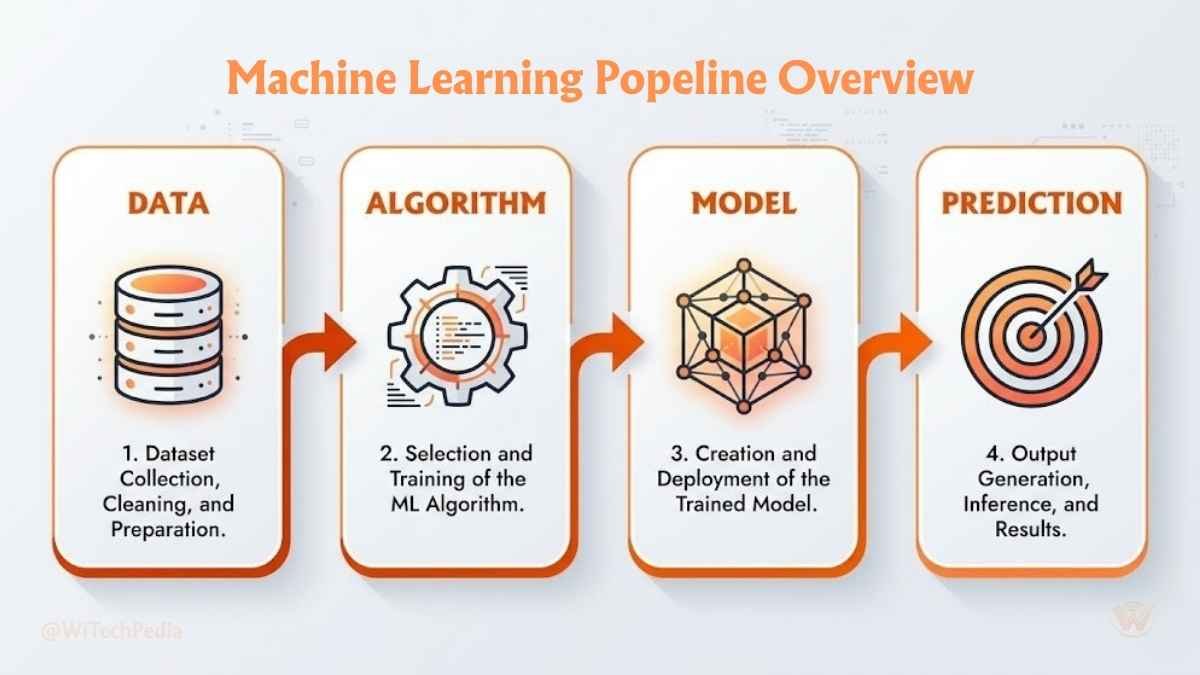
Every ML system boils down to this:
Data → Algorithm → Model → Prediction
- Data is the raw input (images, text, numbers, sensor readings).
- Algorithm is the mathematical method used to find patterns.
- Model is the trained output — the “learned” system.
- Prediction is what the model outputs on new, unseen data.
A Brief History of Machine Learning
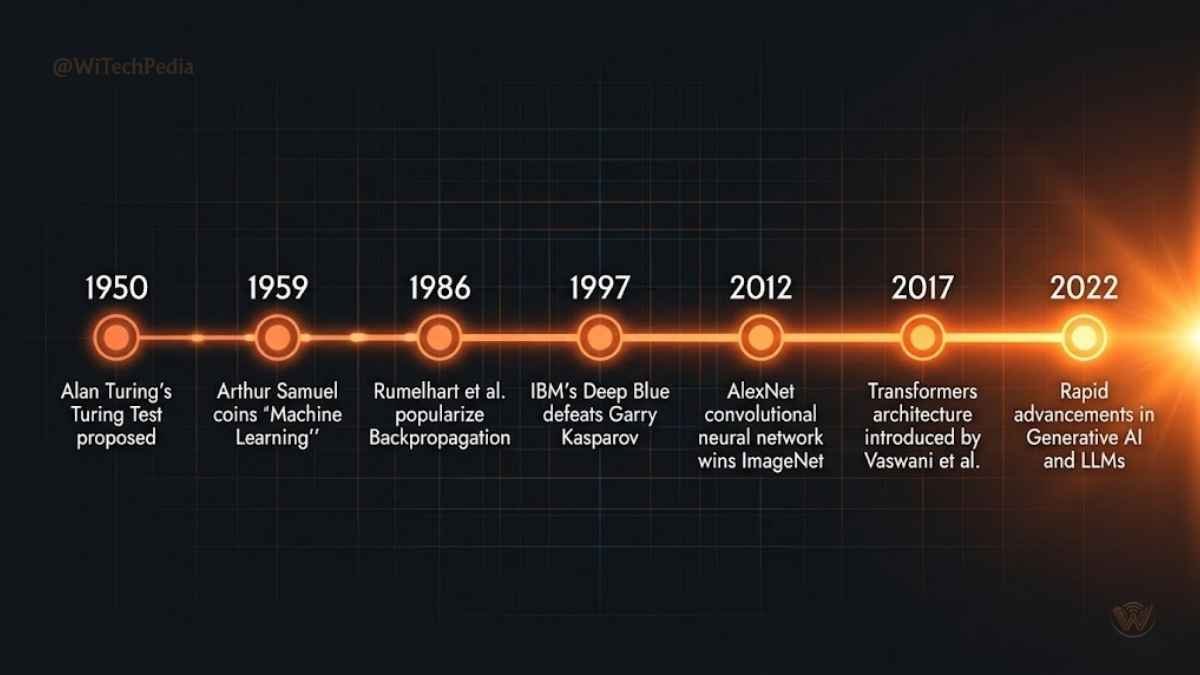
Machine learning didn’t appear overnight. Its roots trace back decades:
- 1950 — Alan Turing asks, “Can machines think?” and proposes the Turing Test.
- 1959 — Arthur Samuel coins the term “machine learning” while building a checkers-playing program at IBM.
- 1986 — Backpropagation algorithm revolutionizes neural network training.
- 1997 — IBM’s Deep Blue defeats chess world champion Garry Kasparov.
- 2012 — Deep learning breakthrough: AlexNet wins the ImageNet competition by a massive margin.
- 2017 — Google’s AlphaGo defeats the world Go champion, a feat experts thought was a decade away.
- 2022–present — Large language models (LLMs) like GPT-4 bring ML into mainstream daily use.
The Three Types of Machine Learning
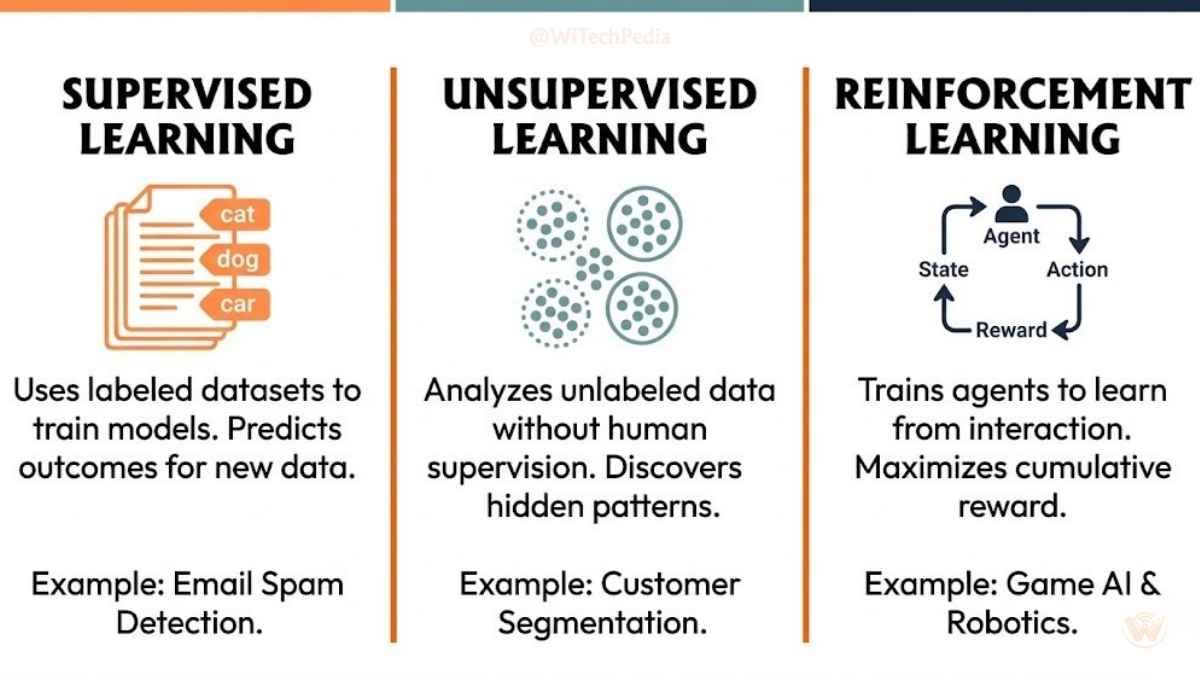
Understanding machine learning starts with knowing its three core paradigms.
1. Supervised Learning
In supervised learning, the algorithm trains on labeled data — input-output pairs where the correct answer is already known.
How it works: The model learns the mapping from inputs to outputs and generalizes to predict outputs for new inputs.
Common algorithms:
- Linear Regression
- Logistic Regression
- Support Vector Machines (SVM)
- Random Forest
- Gradient Boosting (XGBoost, LightGBM)
Real-world use cases:
- Email spam detection (spam / not spam)
- Loan default prediction (will this borrower repay?)
- Image classification (cat vs. dog)
- Medical diagnosis (tumor benign vs. malignant)
2. Unsupervised Learning
Here, the algorithm works with unlabeled data. There are no correct answers to guide it — only raw patterns to discover.
How it works: The model finds hidden structure, clusters, or relationships in the data on its own.
Common algorithms:
- K-Means Clustering
- DBSCAN
- Principal Component Analysis (PCA)
- Autoencoders
Real-world use cases:
- Customer segmentation in marketing
- Anomaly detection in cybersecurity
- Topic modeling in text analysis
- Recommendation systems (early-stage grouping)
3. Reinforcement Learning
In reinforcement learning (RL), an agent learns by interacting with an environment. It receives rewards for good actions and penalties for bad ones — learning a strategy (policy) to maximize cumulative reward over time.
How it works: Trial, error, reward signal, repeat.
Real-world use cases:
- Game-playing AI (AlphaGo, OpenAI Five)
- Autonomous vehicle navigation
- Robotic arm control in manufacturing
- Personalized ad bidding in real-time auctions
Machine Learning vs. Deep Learning vs. AI
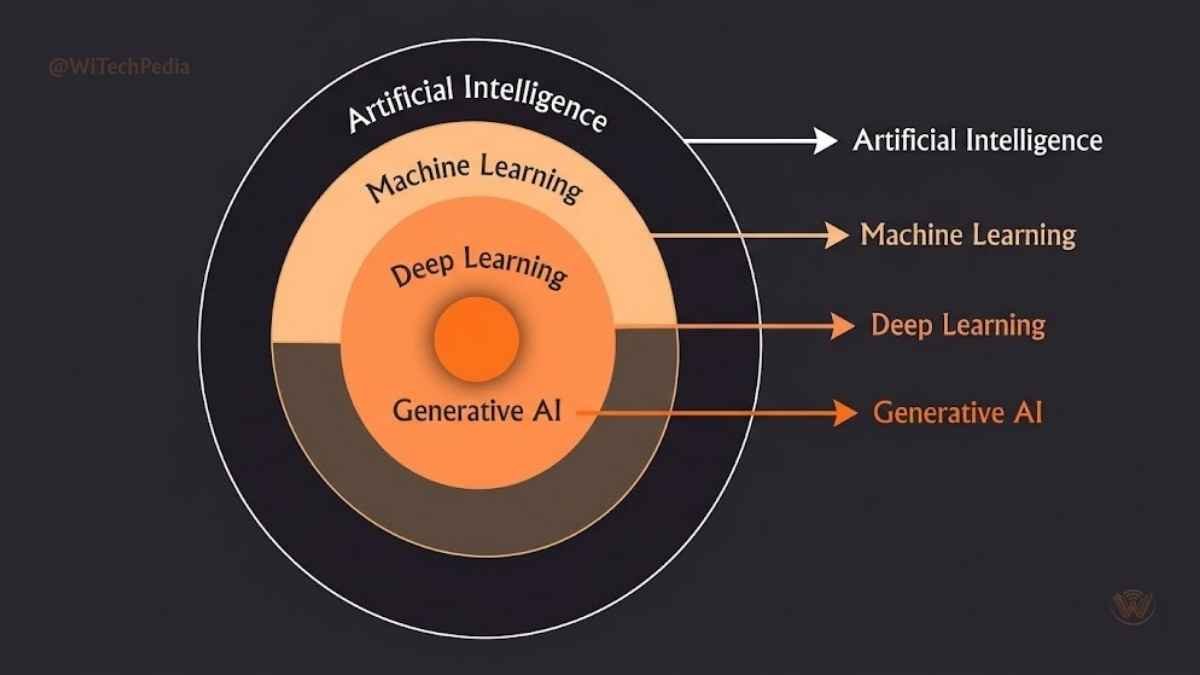
These three terms are frequently confused. Here’s the definitive breakdown:
| Concept | Definition | Scope | Key Technique |
|---|---|---|---|
| Artificial Intelligence (AI) | Machines simulating human intelligence | Broadest | Rules, ML, reasoning |
| Machine Learning (ML) | Systems that learn from data | Subset of AI | Statistical models |
| Deep Learning (DL) | ML using multi-layered neural networks | Subset of ML | Neural networks |
| Generative AI | AI that creates new content | Subset of DL | LLMs, diffusion models |
The relationship is nested: AI ⊃ ML ⊃ Deep Learning ⊃ Generative AI
Learn more about Deep Learning →
Key Machine Learning Algorithms
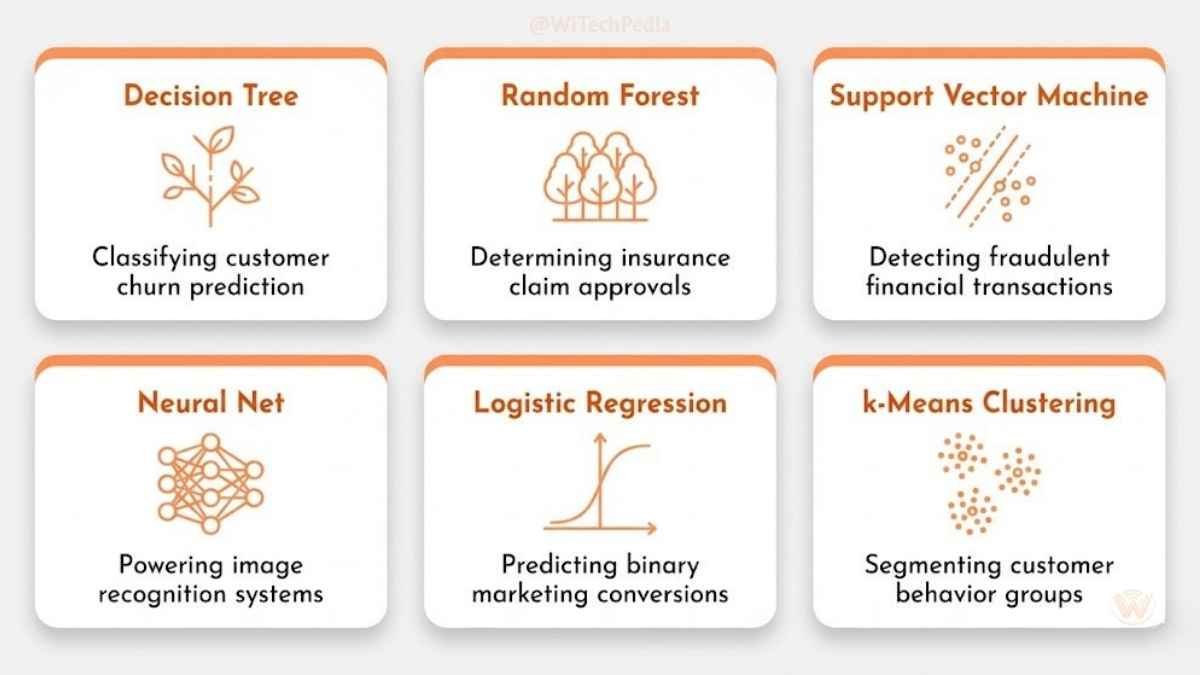
Decision Trees
A flowchart-like model where each node represents a feature, each branch a decision, and each leaf a result. Simple, interpretable, and surprisingly powerful.
Best for: Classification, customer churn prediction, medical triage.
Random Forest
An ensemble of hundreds of decision trees, each trained on a random data subset. The majority vote wins. Reduces overfitting dramatically compared to a single tree.
Best for: High-accuracy classification, feature importance ranking.
Neural Networks
Layers of interconnected nodes (“neurons”) that transform inputs into outputs through learned weights. The backbone of deep learning.
Best for: Image recognition, language modeling, complex pattern detection.
Support Vector Machines (SVM)
Finds the optimal boundary (hyperplane) that best separates classes in high-dimensional space.
Best for: Text classification, bioinformatics, small-to-medium datasets.
K-Nearest Neighbors (KNN)
Classifies a data point based on the majority class of its K closest neighbors in feature space.
Best for: Simple classification, recommendation systems, anomaly detection.
Gradient Boosting (XGBoost / LightGBM)
Builds an ensemble of weak learners sequentially, each correcting the errors of the last. Dominates tabular data competitions.
Best for: Kaggle competitions, fraud detection, financial modeling.
How Machine Learning Works: The Training Pipeline
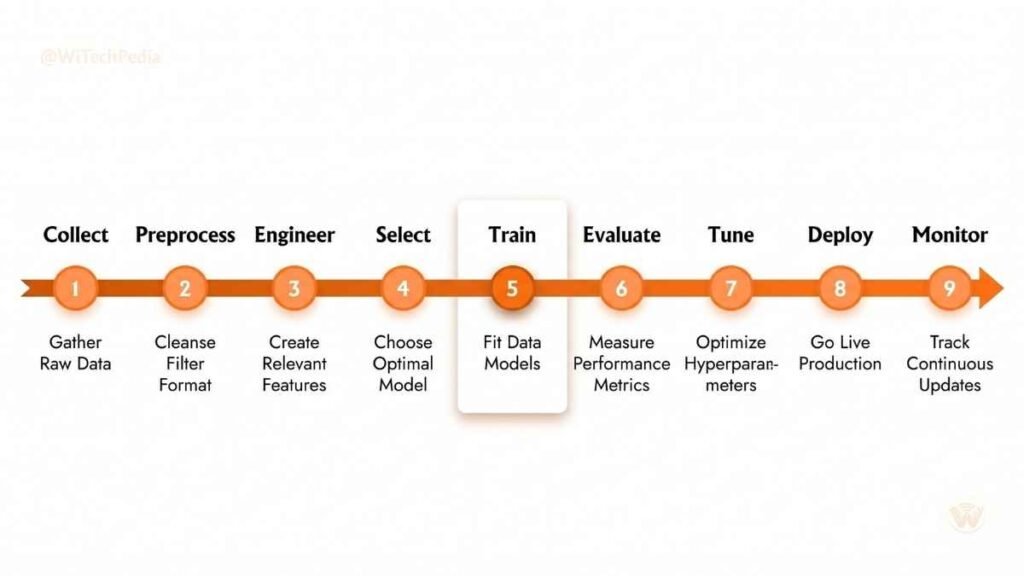
Here’s what actually happens under the hood when you “train” a model:
- Data Collection — Gather raw data from sensors, databases, APIs, web scrapes, or manual labeling.
- Data Preprocessing — Clean missing values, handle outliers, encode categorical variables, normalize features.
- Feature Engineering — Select and transform the most informative variables; create new features from raw data.
- Model Selection — Choose the algorithm that fits the problem type (classification, regression, clustering).
- Training — Feed the model training data; it adjusts internal parameters to minimize prediction error.
- Evaluation — Test on held-out data using metrics: accuracy, precision, recall, F1-score, AUC-ROC.
- Hyperparameter Tuning — Optimize model configuration (learning rate, depth, regularization).
- Deployment — Serve the model via API, edge device, or embedded system.
- Monitoring — Track performance over time; retrain as data drifts.
Real-World Applications of Machine Learning
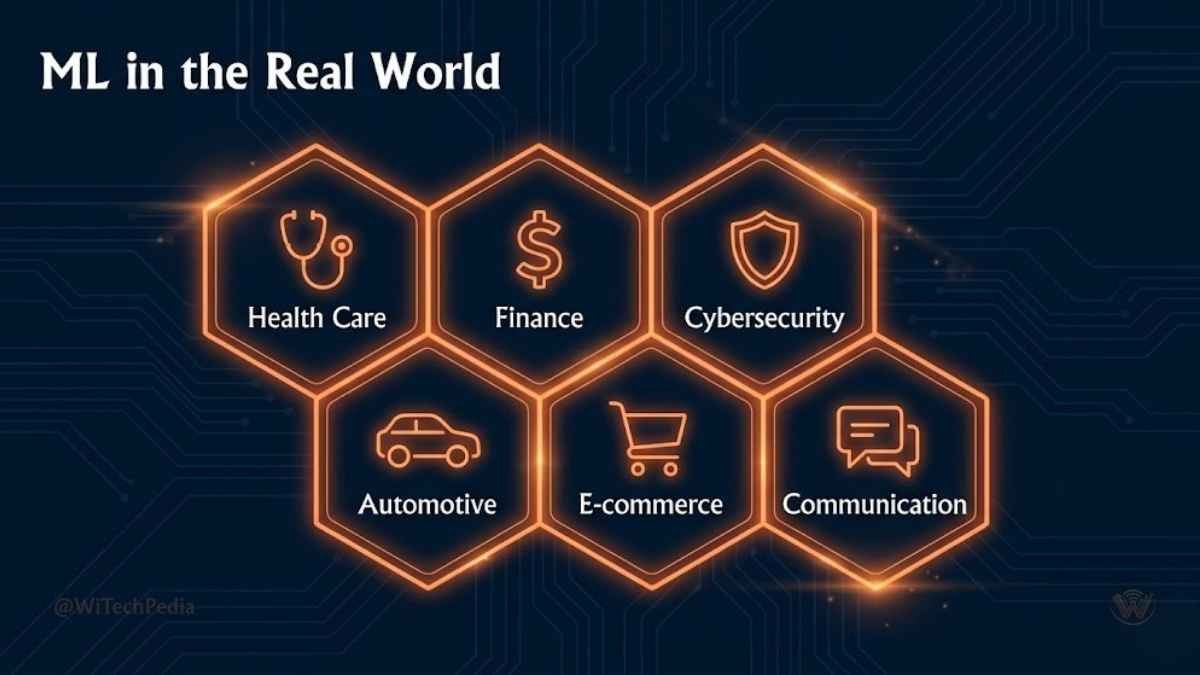
Machine learning is no longer experimental. It runs the world’s most critical systems today.
Healthcare
- Diagnostic imaging: Google’s DeepMind detects over 50 eye diseases from retinal scans with accuracy matching top ophthalmologists.
- Drug discovery: ML models predict molecular interactions, cutting drug development timelines from 12 years to under 4.
- Predictive care: Hospitals use ML to predict patient deterioration 6+ hours before clinical collapse.
Finance
- Fraud detection: Visa’s ML systems analyze 65,000 transactions per second, flagging anomalies in real time.
- Algorithmic trading: Quant funds use reinforcement learning models to execute millions of micro-trades daily.
- Credit scoring: ML models assess creditworthiness using hundreds of behavioral signals — not just salary.
Cybersecurity
- Threat detection: ML identifies zero-day exploits by spotting behavior anomalies, not known signatures.
- Phishing detection: Email providers use NLP-based models to detect phishing with >99.9% accuracy.
Transportation
- Autonomous vehicles: Tesla’s Autopilot, Waymo’s robotaxi, and Cruise all rely on deep learning for real-time perception.
- Route optimization: Google Maps uses ML to predict traffic and recalculate routes in milliseconds.
Retail & E-Commerce
- Recommendation engines: Amazon attributes 35% of its revenue to its ML-powered recommendation system.
- Dynamic pricing: Airlines and ride-sharing platforms adjust prices in real time using demand ML models.
Natural Language Processing (NLP)
- Chatbots & virtual assistants: Siri, Alexa, Google Assistant, and ChatGPT all run on ML-based NLP.
- Translation: Google Translate processes over 100 billion words per day using neural machine translation.
Popular Machine Learning Frameworks & Tools
| Framework | Language | Best For | Developer |
|---|---|---|---|
| TensorFlow | Python, JS | Production ML, deep learning | |
| PyTorch | Python | Research, NLP, CV | Meta AI |
| Scikit-learn | Python | Classical ML, prototyping | Community |
| XGBoost | Python, R | Tabular data, competitions | DMLC |
| Keras | Python | Fast prototyping, neural nets | |
| Hugging Face | Python | NLP, LLMs, fine-tuning | Hugging Face |
| Apache Spark MLlib | Python, Scala | Big data ML at scale | Apache |
Machine Learning Challenges and Limitations
No technology is without limits. ML comes with significant caveats:
- Data dependency: ML models are only as good as their training data. Garbage in, garbage out.
- Bias and fairness: Models trained on biased data reproduce and amplify those biases. This is a critical ethical issue in hiring, lending, and criminal justice.
- Explainability: Deep learning models are often “black boxes” — their decisions are hard to interpret.
- Overfitting: A model can memorize training data instead of generalizing, failing badly on new inputs.
- Computational cost: Training large models requires massive GPU clusters and enormous energy consumption.
- Data privacy: ML training often requires sensitive personal data, raising GDPR and compliance concerns.
The Future of Machine Learning
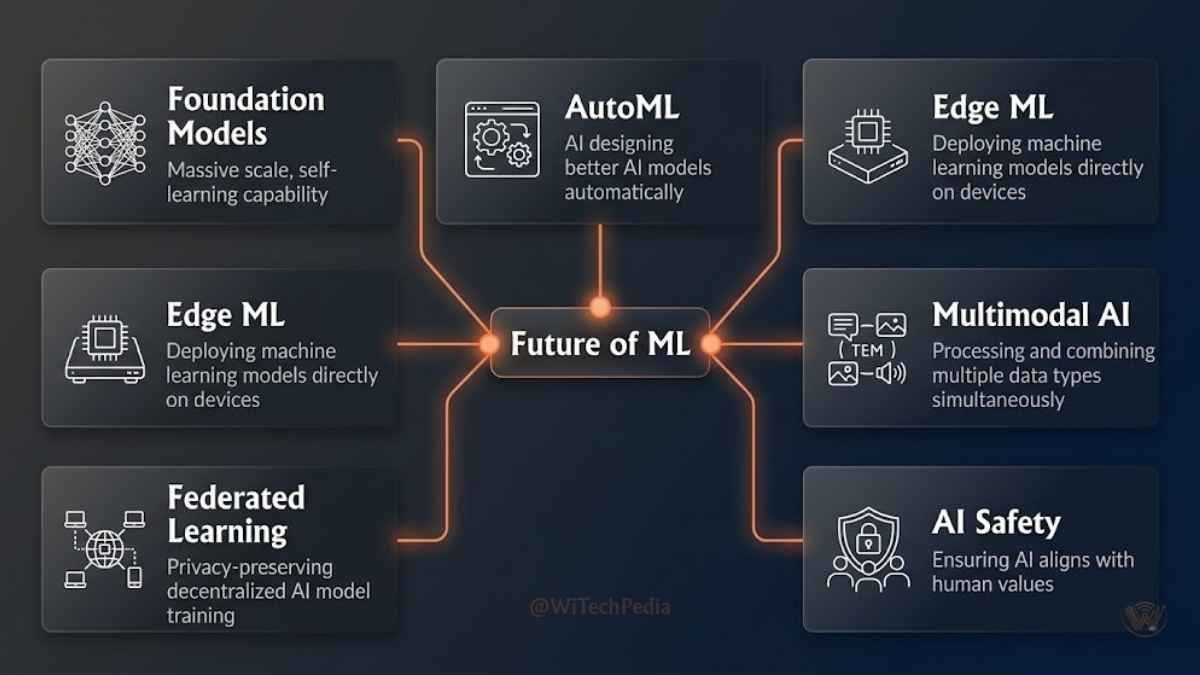
Several trends are shaping where ML goes next:
- Foundation Models: Massive pre-trained models (GPT-4, Gemini, Claude) that can be fine-tuned for dozens of tasks at once.
- AutoML: Tools like Google AutoML and H2O.ai that automate model selection and tuning for non-experts.
- Edge ML: Running models on-device (phones, IoT sensors) without cloud dependency — critical for privacy and latency.
- Federated Learning: Training models across decentralized devices without centralizing data.
- Multimodal AI: Models that process text, image, audio, and video simultaneously.
- AI Safety & Alignment: As models grow more capable, aligning their behavior with human values becomes critical.
Frequently Asked Questions (FAQ)
What is machine learning in simple terms?
Machine learning is a method where computers learn from data rather than following explicit rules. By analyzing patterns in large datasets, ML models improve their performance on tasks over time — similar to how humans learn from experience, but at machine speed and scale.
What are the main types of machine learning?
The three primary types are: supervised learning (learning from labeled data to predict outputs), unsupervised learning (finding hidden patterns in unlabeled data), and reinforcement learning (learning through trial, error, and reward signals in an environment).
How is machine learning different from traditional programming?
In traditional programming, developers write explicit rules: if X, then Y. In machine learning, the algorithm discovers rules automatically by analyzing examples. Traditional code tells the computer what to do; ML shows the computer what outcomes look like and lets it figure out the path.
What is the difference between AI, machine learning, and deep learning?
Artificial Intelligence is the broadest field — any technique that enables machines to mimic human intelligence. Machine learning is a subset of AI that learns from data. Deep learning is a subset of machine learning that uses multi-layered neural networks, excelling at unstructured data like images and language.
Do I need to know math to learn machine learning?
A solid foundation in linear algebra, calculus, statistics, and probability helps you understand how algorithms work at a deep level. However, you can start building ML models today with Python libraries like Scikit-learn and work backward to the math as you encounter specific concepts. Many practitioners follow this path successfully.
What programming language is best for machine learning?
Python is the overwhelming industry standard for machine learning, thanks to its rich ecosystem (TensorFlow, PyTorch, Scikit-learn, Pandas, NumPy). R is used in academic and statistical research. Julia is gaining traction for high-performance numerical computing.
What jobs use machine learning?
Key ML careers include: Machine Learning Engineer, Data Scientist, AI Researcher, NLP Engineer, Computer Vision Engineer, MLOps Engineer, and Quantitative Analyst. ML skills are also increasingly valuable for software engineers, product managers, and domain experts in healthcare, finance, and logistics.
The Bottom Line: Why Machine Learning Matters
Machine learning has moved from research labs to the backbone of everyday life. Here are the top takeaways from this guide:
- Machine learning enables systems to learn from data — without being programmed rule-by-rule.
- There are three core types: supervised, unsupervised, and reinforcement learning — each for different problem shapes.
- Deep learning is a powerful subset that drives image recognition, language models, and generative AI.
- Real-world applications span every sector — healthcare, finance, transport, retail, and cybersecurity.
- The field is evolving rapidly — foundation models, edge ML, and federated learning are defining the next decade.
The people who understand machine learning won’t just use the tools it creates — they’ll build them.
Ready to go deeper? Subscribe to the WiTechPedia newsletter for weekly deep dives into AI, computing, and the technology shaping our world.