








The history of artificial intelligence shows how humans turned bold ideas into powerful tools that now shape our world. Researchers built machines that learn, reason, and act. Today, in April 2026, Agentic AI stands at the frontier. This article gives you the complete timeline, clear milestones, and practical insights.
- Early Ideas and Foundations (1940s – 1960s)
- The First AI Winters (1970s – 1980s)
- Revival and Machine Learning Era (1990s – 2000s)
- The Deep Learning Breakthrough (2010 – 2020)
- Generative AI and Current Era (2022 Onwards)
- Major Milestones Timeline
- Glossary of Important Terms
- Frequently Asked Questions (FAQ)
- Conclusion
Early Ideas and Foundations (1940s – 1960s)
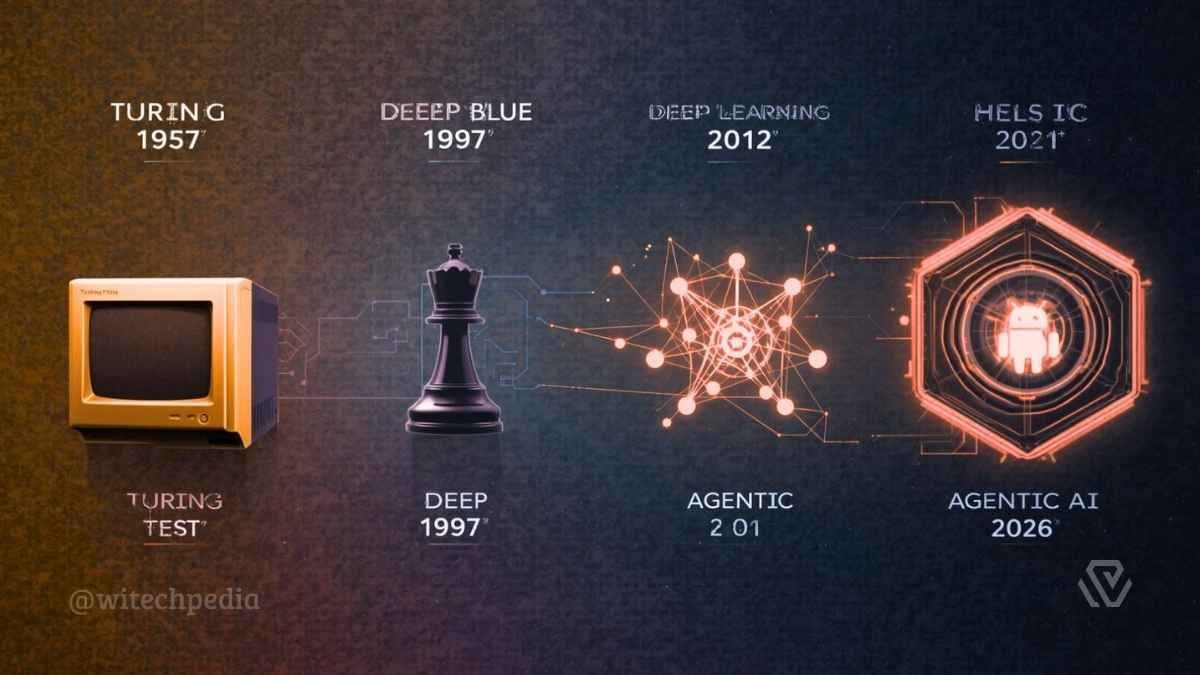
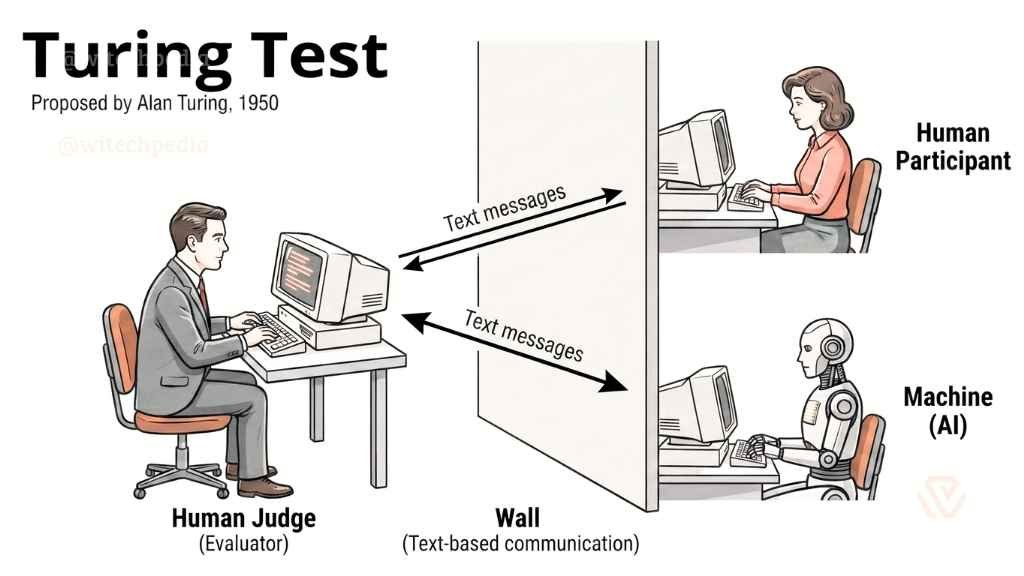
Alan Turing laid the groundwork in 1950. He published the paper “Computing Machinery and Intelligence.” He introduced the Turing Test to check if a machine could behave like a human.
In 1956, scientists gathered at the Dartmouth Conference. John McCarthy, Marvin Minsky, Nathaniel Rochester, and Claude Shannon officially coined the term “artificial intelligence.” This event marked the official birth of AI as a research field.
Scientists created the first programs in the late 1950s and 1960s. Frank Rosenblatt developed the Perceptron in 1957. It became one of the earliest neural network models. In 1966, Joseph Weizenbaum created ELIZA, an early chatbot that could hold simple conversations.
The First AI Winters (1970s – 1980s)
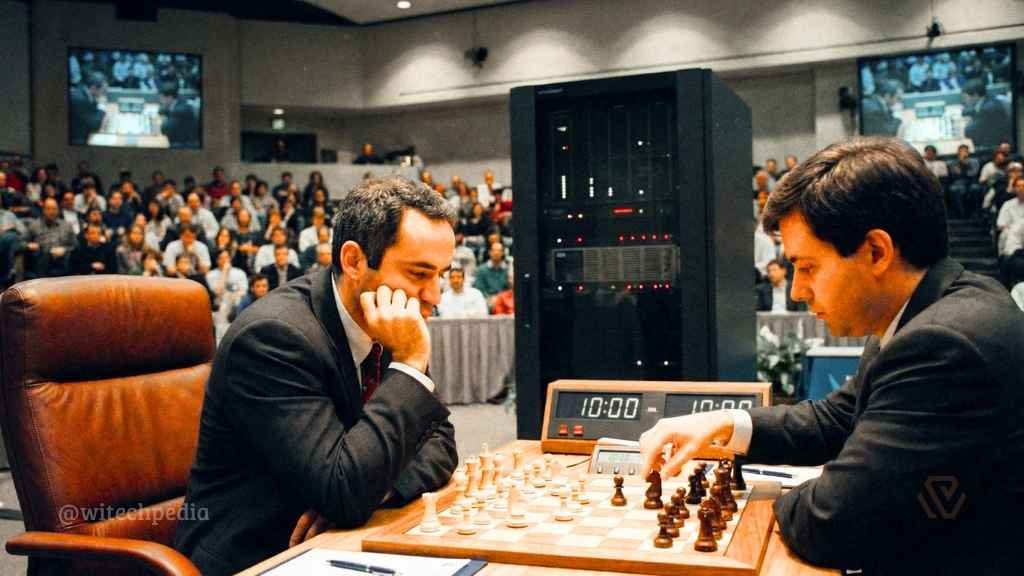
IBM’s Deep Blue defeated chess champion Garry Kasparov in 1997. This event showed the world that machines could beat humans in complex games.
Researchers shifted focus to machine learning. Instead of writing every rule, they let systems learn from data. Support Vector Machines and decision trees gained popularity. By the early 2000s, AI started solving practical business problems.
Revival and Machine Learning Era (1990s – 2000s)
IBM’s Deep Blue defeated chess champion Garry Kasparov in 1997. This event showed the world that machines could beat humans in complex games.
Researchers shifted focus to machine learning. Instead of writing every rule, they let systems learn from data. Support Vector Machines and decision trees gained popularity. By the early 2000s, AI started solving practical business problems.
The Deep Learning Breakthrough (2010 – 2020)
The year 2012 became a turning point. AlexNet won the ImageNet competition. This deep neural network dramatically improved image recognition. The success proved the power of deep learning.
Google acquired DeepMind in 2014. In 2016, DeepMind’s AlphaGo defeated world champion Lee Sedol in the game of Go. The victory surprised experts because Go is far more complex than chess.
OpenAI released GPT-3 in 2020. The large language model showed impressive natural language abilities. These developments created massive interest and investment in AI.
Generative AI and Current Era (2022 Onwards)
ChatGPT launched in November 2022. It reached 100 million users faster than any previous technology. Multimodal models that understand text, images, and voice appeared soon after.
Today, artificial intelligence powers recommendation systems, autonomous vehicles, medical diagnosis, and creative tools. Companies integrate AI into daily workflows across the globe.
Major Milestones Timeline
Glossary of Important Terms
Frequently Asked Questions (FAQ)
What is the history of artificial intelligence?
The history of artificial intelligence started in the 1950s with Alan Turing and the Dartmouth Conference. It moved through periods of excitement and disappointment before achieving major breakthroughs after 2010.
When did modern AI begin?
Modern AI began around 2012 with the success of deep learning and AlexNet. The launch of ChatGPT in 2022 further accelerated its growth.
Why should I study the history of artificial intelligence?
Studying this history helps you understand current AI capabilities, avoid past mistakes, and make better decisions about future technology adoption.
Conclusion
The history of artificial intelligence proves that consistent effort and technological progress can turn science fiction into everyday reality. Each decade built upon the previous one.
You now have a clear understanding of how AI reached its current stage. Use this knowledge to stay ahead in your career and projects.
Next Steps: → Read our complete Tech History & Glossaries → Explore current Emerging Technologies → Watch the companion video on our YouTube channel for visual explanations.
Subscribe to the WiTechPedia newsletter to receive new glossaries and updates directly in your inbox.
Share this article with colleagues who want to understand AI better.