








In 2023, generative AI added an estimated $2.6 trillion to $4.4 trillion in annual economic value across industries — and that number is accelerating fast. So what exactly is this technology, and why is every company on the planet racing to adopt it?
Generative AI is no longer a niche research topic. It powers the chatbots answering your support queries, the tools writing your marketing copy, the systems designing drug molecules, and the engines turning rough sketches into polished artwork. Understanding it isn’t optional anymore — it’s foundational literacy for anyone working in tech, business, or creative fields.
- What is Generative AI?
- How Does Generative AI Work?
- Generative AI vs. Traditional AI: Key Differences
- Best Generative AI Models in 2026
- Real-World Applications of Generative AI
- The Risks and Limitations of Generative AI
- Best Generative AI Tools and Models in 2026
- Frequently Asked Questions (FAQs) on Generative AI
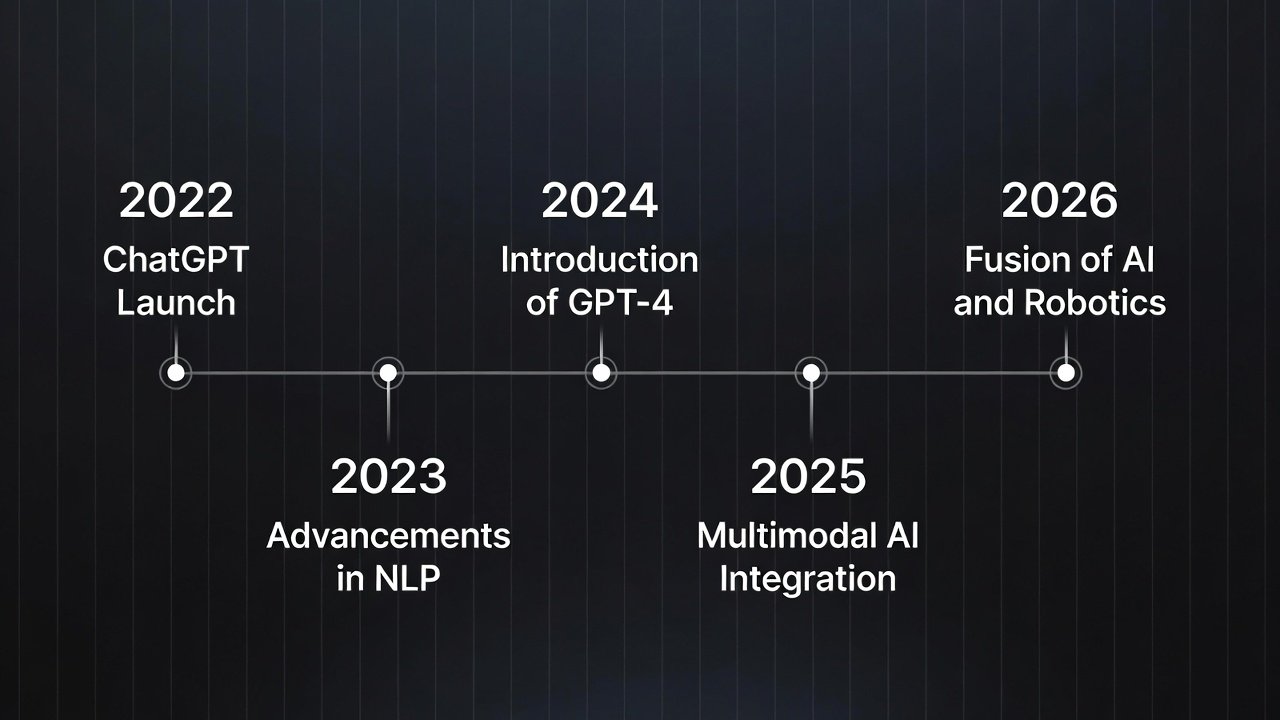
- The Future of Generative AI
- Final Thoughts: Why Generative AI Matters
This guide breaks down everything: what generative AI is, how it works under the hood, the models driving the revolution, real-world applications across industries, and the honest risks you need to understand. Whether you’re a curious beginner or a seasoned developer, this is the only guide you need.
What is Generative AI?
Generative AI refers to a class of artificial intelligence systems capable of producing new, original content — text, images, audio, video, code, 3D models, and more — by learning patterns from vast training datasets.
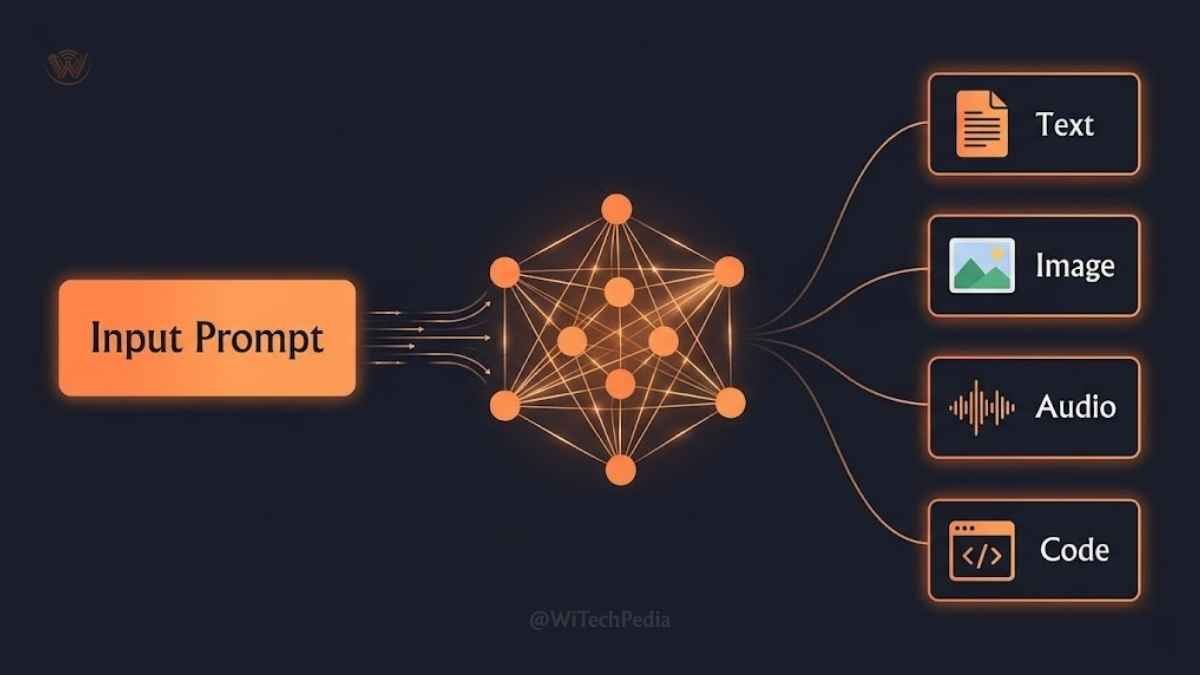
Unlike traditional AI systems, which are designed to classify or predict based on fixed rules, generative AI creates. It doesn’t look up answers from a database. Instead, it synthesizes novel outputs that didn’t exist before, based on statistical patterns it has internalized during training.
The term “generative” comes from the underlying mathematical concept: these models learn the probability distribution of training data and use it to generate new samples that fit within that distribution.
The Core Idea in Plain Language
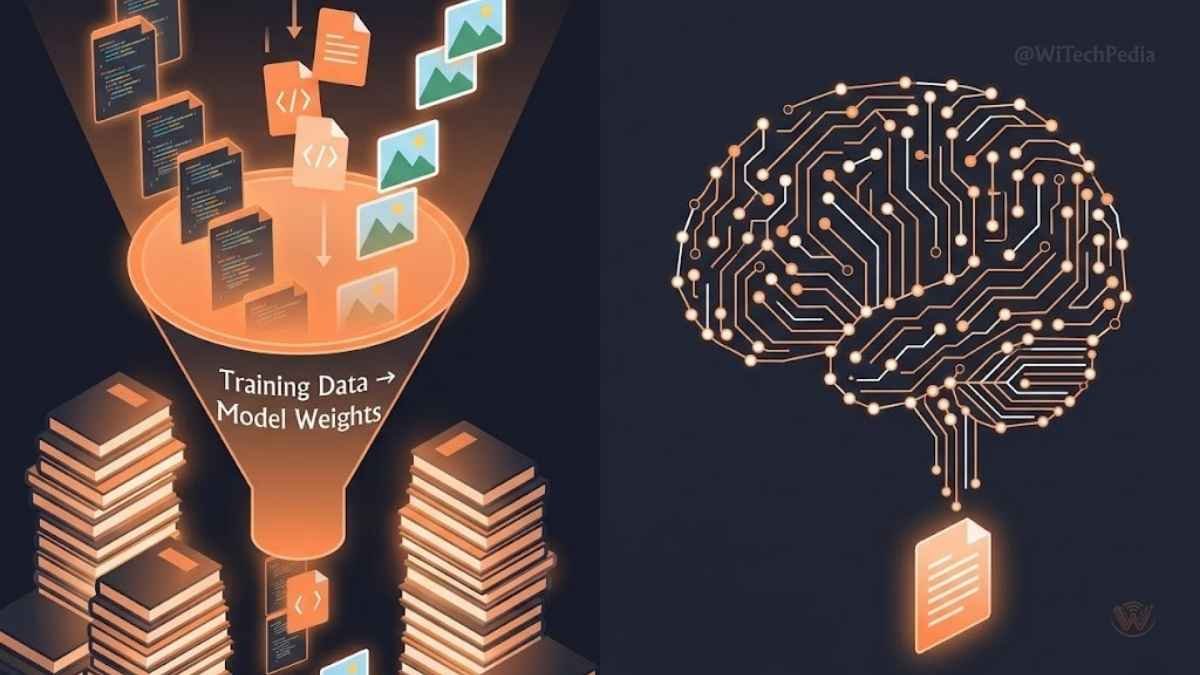
Imagine you read every novel ever written. After enough exposure, you’d internalize the patterns of storytelling — narrative arcs, sentence rhythms, character development, genre conventions. Given a prompt like “write a detective story set in 1920s Paris,” you’d be able to produce something entirely new, yet stylistically coherent.
That’s precisely what generative AI does — at superhuman scale and speed.
How Does Generative AI Work?
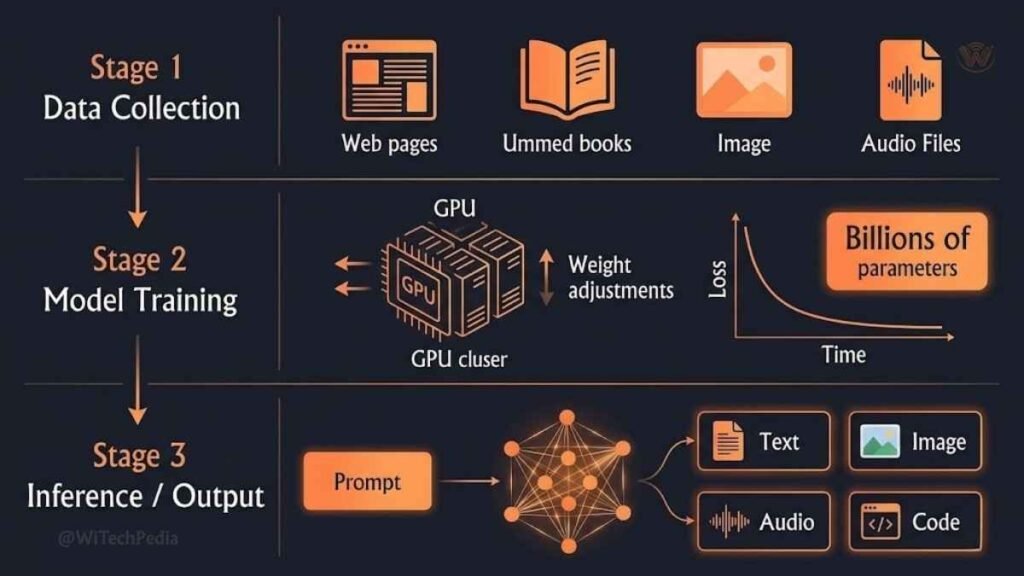
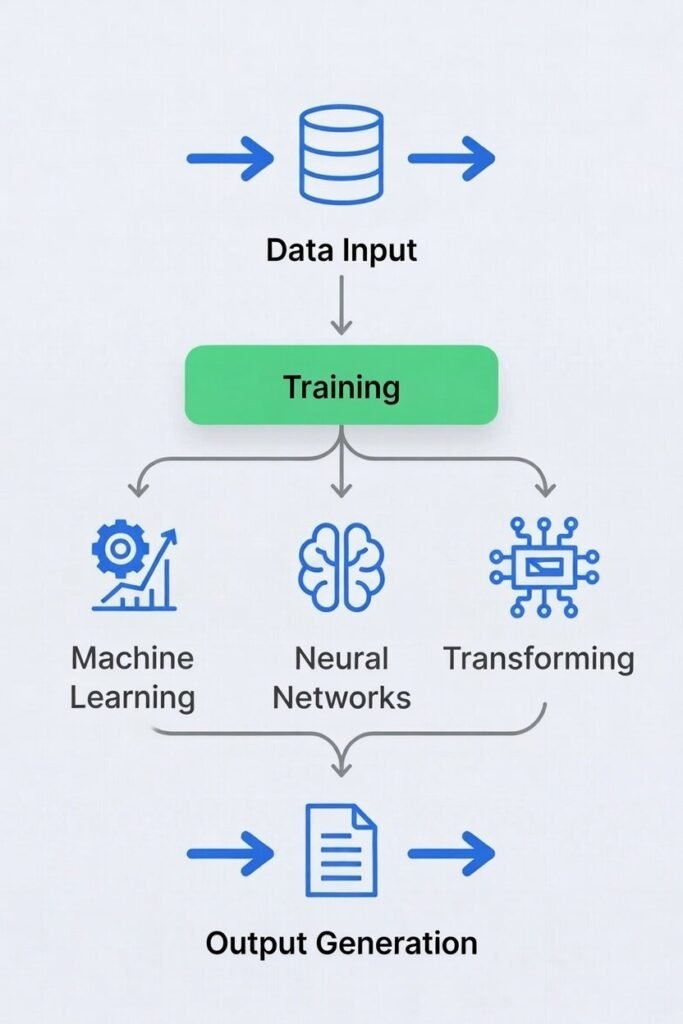
At its core, generative AI is built on deep learning — specifically, neural network architectures trained on massive datasets. Here’s the breakdown:
1. Training on Large Datasets
Generative AI models are trained on enormous corpora of data:
- Language models (like GPT-4, Claude, Gemini): trained on trillions of tokens from the internet, books, code repositories, and scientific papers.
- Image models (like DALL·E 3, Stable Diffusion, Midjourney): trained on hundreds of millions of image-text pairs.
- Audio/video models: trained on hours of speech, music, and video footage.
During training, the model adjusts billions of internal parameters (weights) to minimize prediction error — learning, in essence, what typically follows what.
2. Key Model Architectures
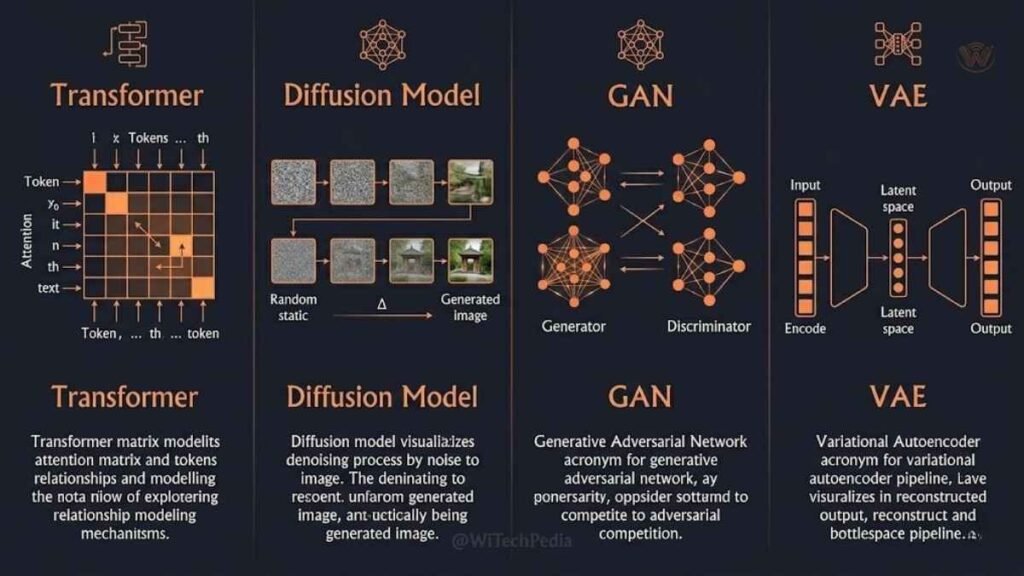
Several neural network architectures power modern generative AI:
Transformers
The dominant architecture for language models. Introduced in the landmark 2017 paper “Attention Is All You Need“ by Vaswani et al., transformers use a self-attention mechanism that allows the model to weigh the relevance of every word to every other word in a sequence simultaneously. This parallel processing enabled training on far larger datasets than previous recurrent architectures allowed.
Most large language models (LLMs) — GPT-4, Claude 3, Gemini 1.5 — are transformer-based.
Diffusion Models
The architecture behind most state-of-the-art image generators. Diffusion models learn to reverse a noise process: they’re trained by gradually adding noise to images until they’re pure static, then learning to reconstruct the original. At inference time, they start from random noise and iteratively denoise toward a coherent image. DALL·E 3, Stable Diffusion, and Midjourney all leverage diffusion techniques.
Generative Adversarial Networks (GANs)
An older but historically important architecture consisting of two neural networks — a generator (creates fake content) and a discriminator (tries to distinguish fake from real) — trained simultaneously in an adversarial loop. GANs were the first models to produce photorealistic images and were widely used for deepfake generation, though diffusion models have largely superseded them for image quality.
Variational Autoencoders (VAEs)
VAEs encode input data into a compressed latent space and learn to decode it back. By sampling from this latent space, new variations of the original data can be generated. Widely used in drug discovery and molecular design applications.
3. Inference: Generating Outputs
Once trained, the model operates in inference mode. Given a prompt (input), it generates an output by sampling from its learned probability distribution — predicting the most likely (or interestingly probable) next token, pixel, or audio frame, one step at a time.

This is why the same prompt can produce slightly different outputs each time — the model samples probabilistically rather than deterministically.
Generative AI vs. Traditional AI: Key Differences
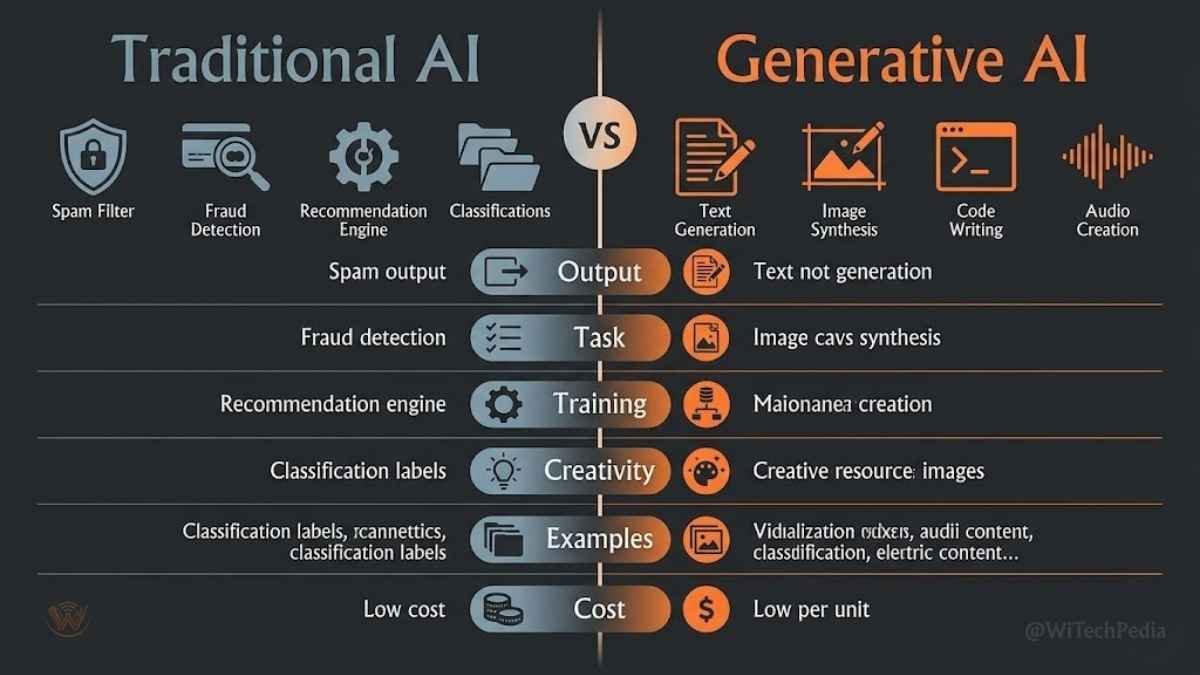
Understanding where generative AI fits requires comparing it to conventional AI paradigms.
| Feature | Traditional AI | Generative AI |
|---|---|---|
| Primary Task | Classification, prediction, optimization | Content creation, synthesis |
| Output | A label, number, or decision | Text, images, audio, video, code |
| Training Approach | Supervised learning on labeled data | Self-supervised learning on raw data |
| Creativity | None — follows predefined rules | High — produces novel content |
| Examples | Spam filters, recommendation engines, fraud detection | ChatGPT, Midjourney, GitHub Copilot |
| Interpretability | Relatively high | Low (black-box behavior) |
| Data Requirements | Moderate | Massive (billions of samples) |
| Compute Cost | Low to moderate | Extremely high |
The distinction matters. Traditional AI systems like fraud detection algorithms or product recommendation engines are powerful and widely deployed — but they don’t create. Generative AI fundamentally expands what machines can do.
Best Generative AI Models in 2026
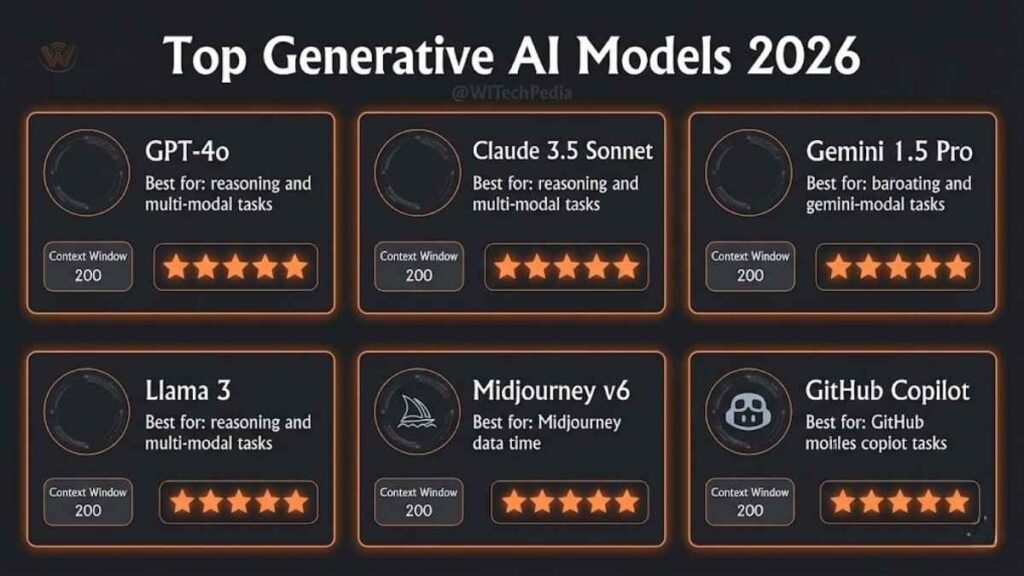
The generative AI landscape has exploded with competing models across every modality. Here’s a comprehensive Generative Ai models list:
Large Language Models (LLMs)
GPT-4o (OpenAI)
OpenAI’s flagship multimodal model processes text, images, and audio natively in a single model. With a 128K context window and significantly faster inference than GPT-4 Turbo, GPT-4o powers ChatGPT’s consumer and enterprise tiers and is available via API for developers. Best for: complex reasoning, coding, document analysis, multilingual tasks.
Claude 3.5 Sonnet (Anthropic)
Anthropic’s Claude 3.5 Sonnet consistently ranks at or near the top of coding and reasoning benchmarks. Designed with a strong emphasis on safety and Constitutional AI — a training methodology that steers models toward helpful, harmless, and honest outputs. Offers a 200K context window, making it exceptional for long-document analysis. Best for: enterprise writing, legal/compliance tasks, coding assistance.
Gemini 1.5 Pro (Google DeepMind)
Google’s Gemini 1.5 Pro features a breakthrough 1 million token context window — the largest commercially available — enabling analysis of entire codebases, hour-long videos, or thousands of documents in a single prompt. Deeply integrated with Google Workspace. Best for: multimodal tasks, video understanding, large-scale document processing.
Llama 3 (Meta AI)
Meta’s open-source LLM family, with versions ranging from 8B to 70B parameters, democratizes access to powerful language models. Llama 3 can run on consumer hardware, enabling private, on-device AI without cloud dependency. Best for: researchers, developers building custom applications, privacy-sensitive deployments.
Mistral & Mixtral (Mistral AI)
The Paris-based startup punches above its weight — Mixtral 8x7B (a Mixture of Experts architecture) delivers performance competitive with much larger models at a fraction of the compute cost. Fully open-weights. Best for: efficient inference, European data-sovereignty requirements.
Image Generation Models
DALL·E 3 (OpenAI)
Integrated directly into ChatGPT, DALL·E 3 excels at following nuanced, complex prompts with high fidelity. Automatically rewrites prompts for safety compliance. Best for: marketing assets, concept visualization, product mockups.
Midjourney v6
Produces the most aesthetically refined, photorealistic images of any consumer tool. Operates via Discord. The go-to for creative professionals, artists, and designers. Best for: artistic illustration, advertising imagery, fashion and product design.
Stable Diffusion (Stability AI)
The fully open-source image model that runs locally. Supports fine-tuning, custom LoRA models, and an enormous community ecosystem via platforms like Civitai and Hugging Face. Best for: custom workflows, privacy-sensitive use cases, game asset generation.
Adobe Firefly
Enterprise-grade image generation trained exclusively on licensed and public domain content, making outputs commercially safe. Deeply integrated into Adobe Creative Cloud. Best for: marketing teams, agencies, professional creatives requiring IP-safe imagery.
Code Generation Models
GitHub Copilot (powered by GPT-4)
The market-leading AI coding assistant, integrated into VS Code, JetBrains, and Neovim. Suggests entire functions, writes tests, explains code, and now includes a chat interface. Used by over 1.8 million developers.
Cursor (Claude-powered)
A VS Code fork that deeply integrates Claude 3.5 Sonnet for codebase-aware assistance. Can reference your entire repository as context, refactor files, and explain architectural decisions.
Amazon CodeWhisperer
Amazon’s answer to Copilot, optimized for AWS services and cloud-native development. Includes security scanning for vulnerabilities.
Audio & Video Models
Sora (OpenAI)
OpenAI’s text-to-video model capable of generating cinematic-quality video clips up to 60 seconds. Still in limited access as of 2025, but represents the most impressive video generation capability publicly demonstrated.
ElevenLabs
The leading text-to-speech and voice cloning platform. Produces near-indistinguishable synthetic voices. Widely used in podcasting, audiobooks, e-learning, and localization.
Runway Gen-3
A professional video generation and editing platform used by filmmakers and content creators. Supports video-to-video transformation, inpainting, and motion brushes.
Real-World Applications of Generative AI
Generative AI is transforming virtually every industry. Here’s where it’s making the deepest impact today:
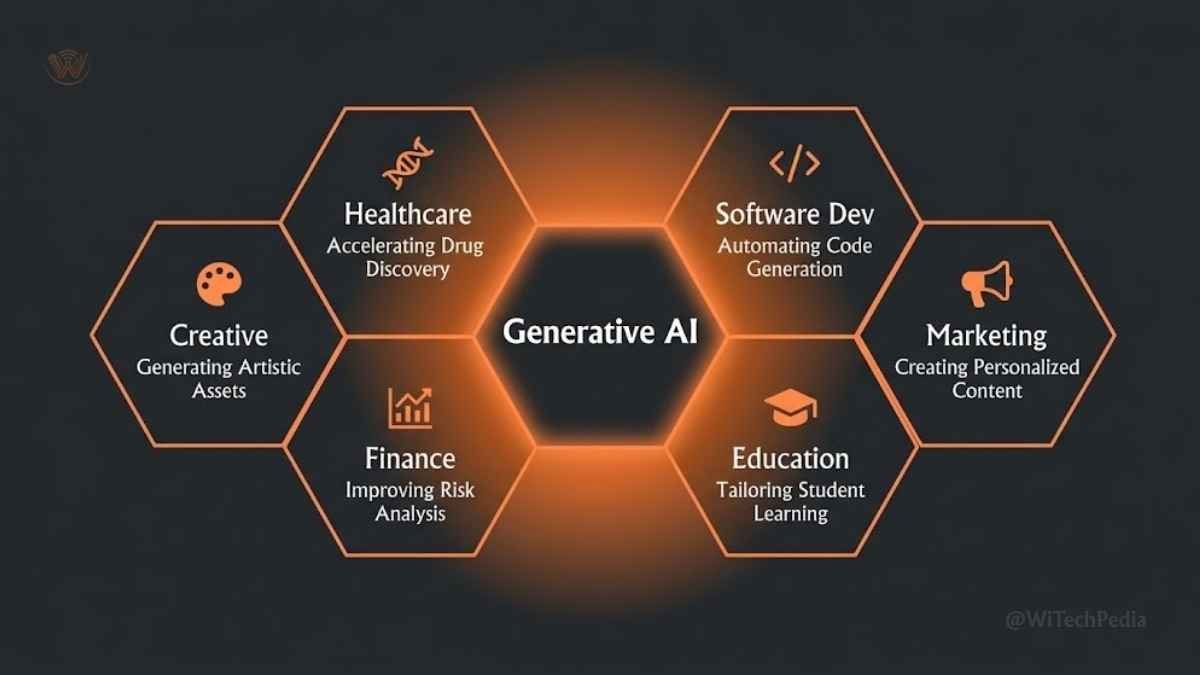
Healthcare & Drug Discovery
- Protein folding: DeepMind’s AlphaFold has predicted structures for over 200 million proteins, dramatically accelerating drug discovery.
- Molecule generation: Models like Insilico Medicine’s Chemistry42 design novel drug candidates, reducing the early-stage discovery timeline from years to weeks.
- Medical imaging: Generative models synthesize training data for rare diseases where real patient scans are scarce.
- Clinical documentation: LLMs transcribe and structure physician notes, reducing administrative burden.
Software Development
- Automated code generation: Copilot and Cursor write boilerplate, suggest completions, and generate full functions from comments.
- Debugging assistance: LLMs explain error messages, suggest fixes, and trace logical errors across large codebases.
- Test generation: Automatically writes unit tests and edge case scenarios.
- Documentation: Generates inline documentation, API references, and README files.
Content & Marketing
- Copy generation: AI drafts ad copy, email campaigns, social posts, and blog articles at scale.
- Personalization: LLMs generate personalized product descriptions and marketing emails for individual users.
- SEO content: Tools like Jasper and Copy.ai accelerate content production, though human editorial oversight remains essential for E-E-A-T compliance.
- Localization: Generative AI translates and culturally adapts content across dozens of languages simultaneously.
Education
- Personalized tutoring: AI tutors like Khan Academy’s Khanmigo adapt explanations to individual student comprehension levels.
- Content creation: Educators generate lesson plans, quizzes, and course materials in minutes.
- Accessibility: Text-to-speech and image description tools make educational content accessible to students with disabilities.
Creative Industries

- Film & VFX: Studios use Stable Diffusion and Runway for concept art, storyboarding, and pre-visualization.
- Music: Tools like Suno and Udio generate full-length songs from text prompts in any genre.
- Game development: AI generates textures, dialogue trees, NPC behaviors, and level layouts.
- Fashion: Generative AI designs garments, predicts trends, and creates virtual try-on experiences.
Finance & Legal
- Document analysis: LLMs review contracts, extract key clauses, and flag risks in seconds.
- Financial reporting: AI generates earnings summaries, analyst reports, and regulatory filings.
- Fraud detection: Generative models create synthetic fraud scenarios to train traditional detection systems.
The Risks and Limitations of Generative AI
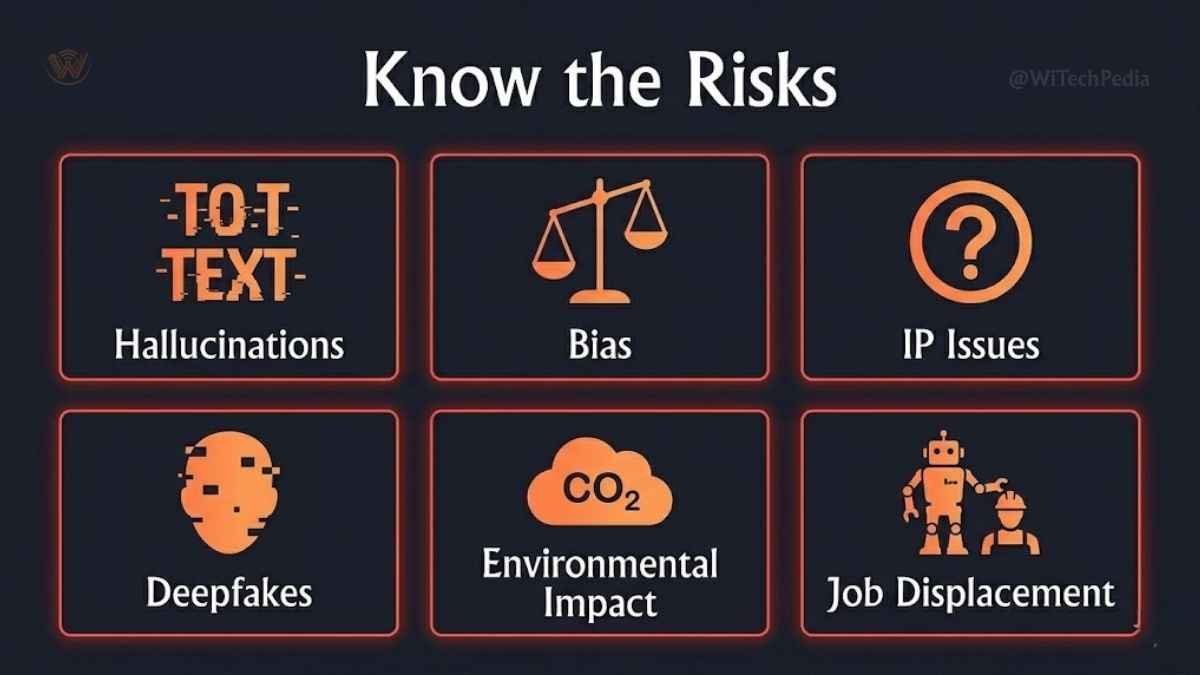
No technology this powerful comes without serious caveats. Here are the risks that deserve your full attention:
Hallucinations
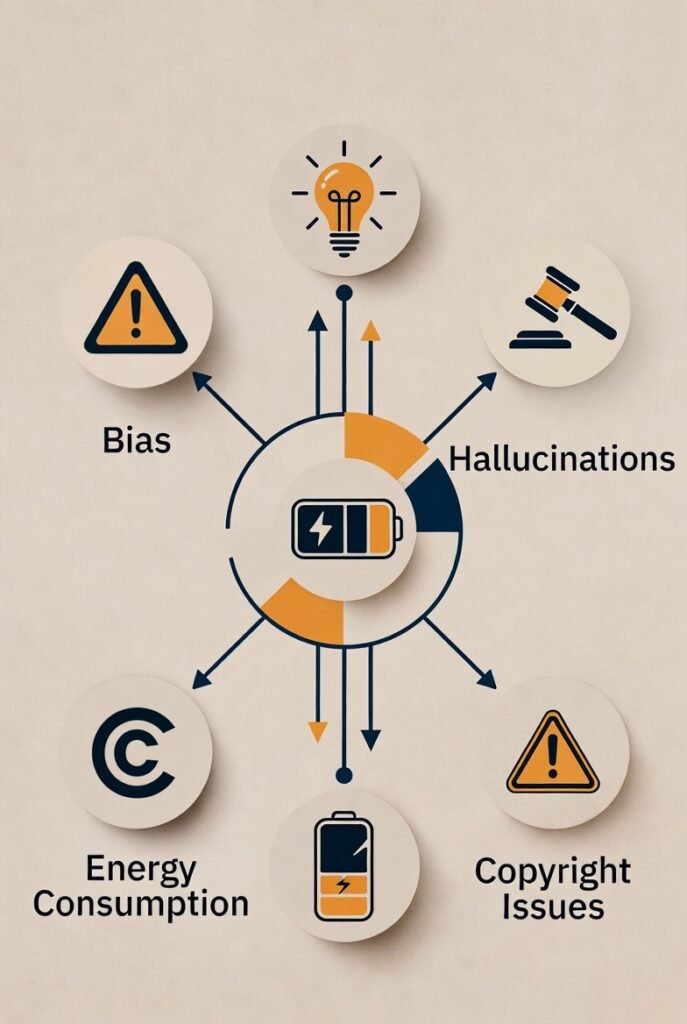
Generative AI models confidently produce false information — invented citations, fabricated statistics, incorrect facts — presented with the same fluency as accurate content. This is called hallucination, and it’s a fundamental limitation of probabilistic generation. Always verify AI-generated factual claims against authoritative sources.
Bias and Fairness
Models inherit the biases present in their training data. This can manifest as stereotypical portrayals, discriminatory outputs, or unequal performance across languages and demographic groups. Responsible deployment requires bias auditing and ongoing monitoring.
Intellectual Property
Generative models trained on copyrighted material raise unresolved legal questions. Several high-profile lawsuits — including Getty Images v. Stability AI and the New York Times v. OpenAI — are testing whether training on copyrighted data constitutes infringement. The legal landscape remains unsettled.
Misinformation & Deepfakes
The same technology that generates photorealistic product images can produce convincing fake news images, synthetic audio of political figures, and deepfake videos. The proliferation of synthetic media poses serious risks to democratic discourse and personal reputation.
Environmental Impact
Training large generative AI models is computationally expensive. GPT-4’s training reportedly consumed energy equivalent to hundreds of thousands of US households for a year. As inference scales to billions of daily queries, the carbon footprint of AI demands urgent attention.
Job Displacement
Generative AI is automating tasks across creative, analytical, and administrative roles. The World Economic Forum estimates 85 million jobs could be displaced by AI by 2025, while 97 million new roles emerge. The transition will be uneven and disruptive.
Best Generative AI Tools and Models in 2026
Selecting the right tools is essential for maximizing value. Here is a curated comparison of the best generative AI tools in 2026:
Enterprise users favor Microsoft 365 Copilot and Perplexity Enterprise for security and integration. Free tiers suffice for beginners, while paid plans unlock higher limits and advanced features.
Frequently Asked Questions (FAQs) on Generative AI
What is generative AI in simple terms?
Generative AI is a type of artificial intelligence that creates new content — text, images, audio, video, or code — by learning patterns from large amounts of existing data. Instead of simply classifying or predicting, it produces original outputs that didn’t exist before. Think of it as an AI that has consumed millions of books, images, or songs and learned to create its own.
How is generative AI different from regular AI?
Traditional AI systems are built to recognize, classify, or predict — spam filters, recommendation algorithms, fraud detection. They work within defined rules on labeled data. Generative AI goes further: it synthesizes entirely new content. The key difference is creativity. A traditional AI can tell you whether an email is spam. A generative AI can write the email.
Is generative AI the same as machine learning?
Generative AI is a subset of machine learning, which is itself a subset of artificial intelligence. Machine learning encompasses all systems that learn from data. Deep learning uses neural networks with many layers. Generative AI specifically refers to deep learning models designed to generate new content — it’s the cutting edge of the broader ML field.
What are the best generative AI tools available today?
For text: ChatGPT (GPT-4o), Claude 3.5 Sonnet, Google Gemini 1.5 Pro. For images: Midjourney v6, DALL·E 3, Adobe Firefly, Stable Diffusion. For code: GitHub Copilot, Cursor, Amazon CodeWhisperer. For video: Sora, Runway Gen-3. For audio: ElevenLabs, Suno. The best tool depends on your specific use case, budget, and privacy requirements.
Is generative AI safe to use?
Generative AI tools are generally safe for most consumer and professional applications when used responsibly. Key precautions: never share sensitive personal data in prompts, always fact-check AI-generated factual claims, verify that AI-generated images are IP-safe for commercial use, and be aware of your organization’s AI usage policies. The technology itself is safe; misuse — disinformation, deepfakes, unchecked automation in high-stakes decisions — is where risk concentrates.
Will generative AI replace human jobs?
Generative AI will transform many jobs rather than simply eliminating them. Roles involving high-volume, repetitive content creation, basic coding tasks, and routine document processing face the highest automation risk. Roles requiring complex judgment, emotional intelligence, strategic thinking, and physical presence are more resilient. The most future-proof posture: learn to use AI tools fluently, so you direct them rather than compete with them.
What is the difference between generative AI and ChatGPT?
ChatGPT is a product — a conversational AI application built by OpenAI using GPT-4 generative AI models. Generative AI is the broader technology class. The relationship is similar to “email” (technology) vs. “Gmail” (product). ChatGPT is one of hundreds of applications built on top of generative AI models.
The Future of Generative AI
The trajectory is steep. Here’s what’s shaping the next phase:
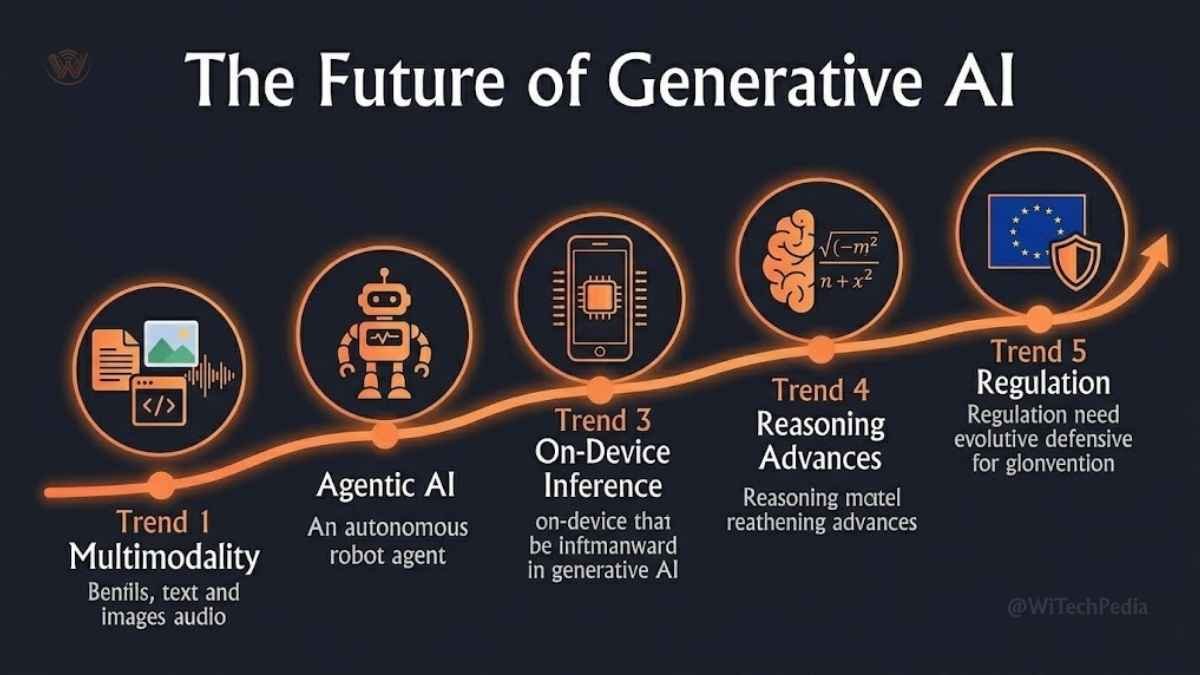
Regulatory frameworks: The EU AI Act (effective 2025) represents the world’s first comprehensive AI regulation, classifying generative AI applications by risk level and mandating transparency requirements. More jurisdictions will follow.
Multimodality becomes standard: Models will natively understand and generate across all modalities simultaneously — text, images, audio, video, and sensor data in a single unified system.
Agentic AI: The shift from models that respond to agents that act — autonomously browsing the web, writing and executing code, managing files, and completing multi-step tasks with minimal human oversight. OpenAI’s Operator and Anthropic’s Claude Computer Use are early indicators.
On-device inference: Smaller, distilled models running locally on smartphones and laptops will bring generative AI to privacy-sensitive applications without cloud dependency.
Reasoning advances: Models like OpenAI’s o1 and DeepSeek R1 demonstrate that extended chain-of-thought reasoning dramatically improves performance on complex math, science, and coding problems — opening doors to genuine scientific discovery.
Final Thoughts: Why Generative AI Matters
Generative AI represents a genuine inflection point in the history of technology — not because it’s perfect, but because it fundamentally expands what’s possible for individuals, organizations, and entire industries.
The technology is still maturing. Hallucinations are real. Bias is real. Legal ambiguity is real. These are problems the field is actively working to solve. But the trajectory is clear: generative AI capabilities are improving faster than almost any technology in history.
Key Takeaways
- Generative AI creates new content — text, images, audio, video, and code — by learning patterns from massive datasets. This is fundamentally different from traditional AI, which classifies and predicts.
- Transformers, diffusion models, and GANs are the key architectures. Understanding which powers which tool helps you use them more effectively.
- The model landscape is competitive and fast-moving. GPT-4o, Claude 3.5 Sonnet, Gemini 1.5 Pro, and open-source alternatives like Llama 3 each have distinct strengths for different use cases.
- Real-world applications span every industry — from drug discovery and software development to content creation and legal document analysis.
- Critical risks — hallucinations, bias, deepfakes, IP issues — demand informed, responsible use. The technology is powerful; how you use it determines whether it creates or destroys value.
The generative AI story is far from over. Want cutting-edge AI insights delivered weekly? Subscribe to the WiTechPedia newsletter — no fluff, just what matters in tech.