








Over 300 million people use AI-powered tools every single day — and most of them have no idea how it works. Artificial Intelligence has gone from a science-fiction dream to the most transformative technology of our lifetime in under a decade. It writes code, diagnoses cancer, drives cars, and composes music.
- What Is Artificial Intelligence?
- A Brief History of Artificial Intelligence
- Types of Artificial Intelligence
- How Does Artificial Intelligence Work?
- Key Branches of AI
- Real-World Applications of Artificial Intelligence
- Major AI Models and Benchmarks (2024–2025)
- The Ethics and Risks of Artificial Intelligence
- The Future of Artificial Intelligence
- Frequently Asked Questions (FAQ)
- Conclusion: Why Artificial Intelligence Is the Defining Technology of Our Era
Yet for all its power, AI remains deeply misunderstood.
This guide changes that. Whether you’re a curious beginner or a seasoned developer, you’ll leave with a clear, authoritative understanding of what AI is, how it actually works, where it’s used, and where it’s headed next.
What Is Artificial Intelligence?
Artificial Intelligence (AI) is the field of computer science focused on building systems capable of performing tasks that normally require human intelligence — such as reasoning, learning, problem-solving, perception, and language understanding.
The term was coined in 1956 by John McCarthy at the Dartmouth Conference, where he defined AI as “the science and engineering of making intelligent machines.” Nearly 70 years later, that definition still holds — but the scale, sophistication, and societal impact have grown beyond anything McCarthy could have imagined.
At its core, AI is about one thing: making machines that can learn and adapt.
A Brief History of Artificial Intelligence
Understanding AI today requires knowing where it came from.
The Founding Era (1950s–1970s)
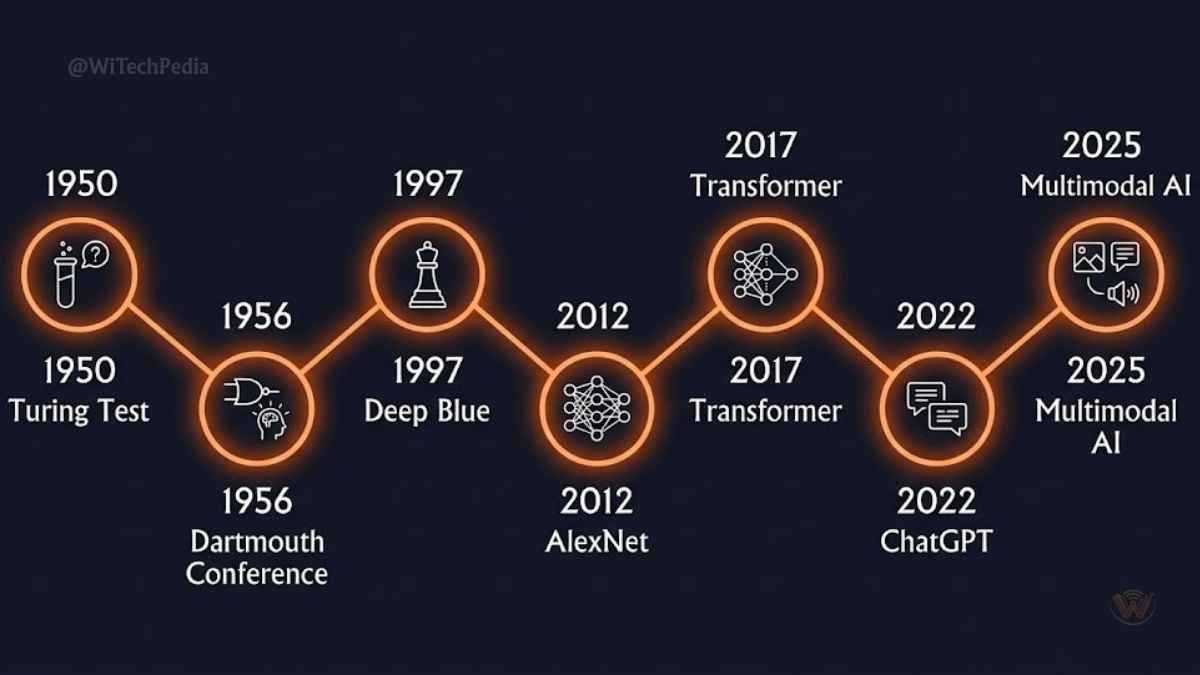
- 1950 — Alan Turing publishes Computing Machinery and Intelligence, introducing the famous Turing Test as a measure of machine intelligence.
- 1956 — The Dartmouth Conference officially births AI as an academic discipline.
- 1966 — ELIZA, the first chatbot, is created at MIT, simulating conversation through pattern matching.
- 1970s — The first AI Winter begins. Overpromised progress leads to funding cuts and disillusionment.
The Expert Systems Boom (1980s)
Rule-based “expert systems” revive interest in AI. Programs like XCON help DEC configure computers, saving millions annually. But brittle logic and high maintenance costs trigger a second AI Winter by the late 1980s.
The Machine Learning Revolution (1990s–2000s)
- 1997 — IBM’s Deep Blue defeats chess world champion Garry Kasparov.
- 2006 — Geoffrey Hinton and colleagues pioneer deep learning, kick-starting the modern AI era.
- 2011 — IBM Watson wins Jeopardy!, showcasing natural language understanding at scale.
The Deep Learning Era (2010s–Present)
- 2012 — AlexNet wins ImageNet with a landmark leap in image recognition accuracy.
- 2016 — DeepMind’s AlphaGo defeats Go world champion Lee Sedol.
- 2020 — OpenAI releases GPT-3, with 175 billion parameters, demonstrating remarkable language fluency.
- 2022–2025 — The era of large language models (LLMs) and multimodal AI: ChatGPT, Gemini, Claude, Llama, and Mistral reshape how humans interact with technology.
Check out our complete guide on The History of Artificial Intelligence: From the Turing Test to Agentic AI (1950–2026) for better understanding in AI History.
Types of Artificial Intelligence
AI is not one technology — it’s a spectrum. Researchers classify it in two primary ways: by capability and by functionality.
By Capability
| Type | Also Known As | Description | Current Status |
|---|---|---|---|
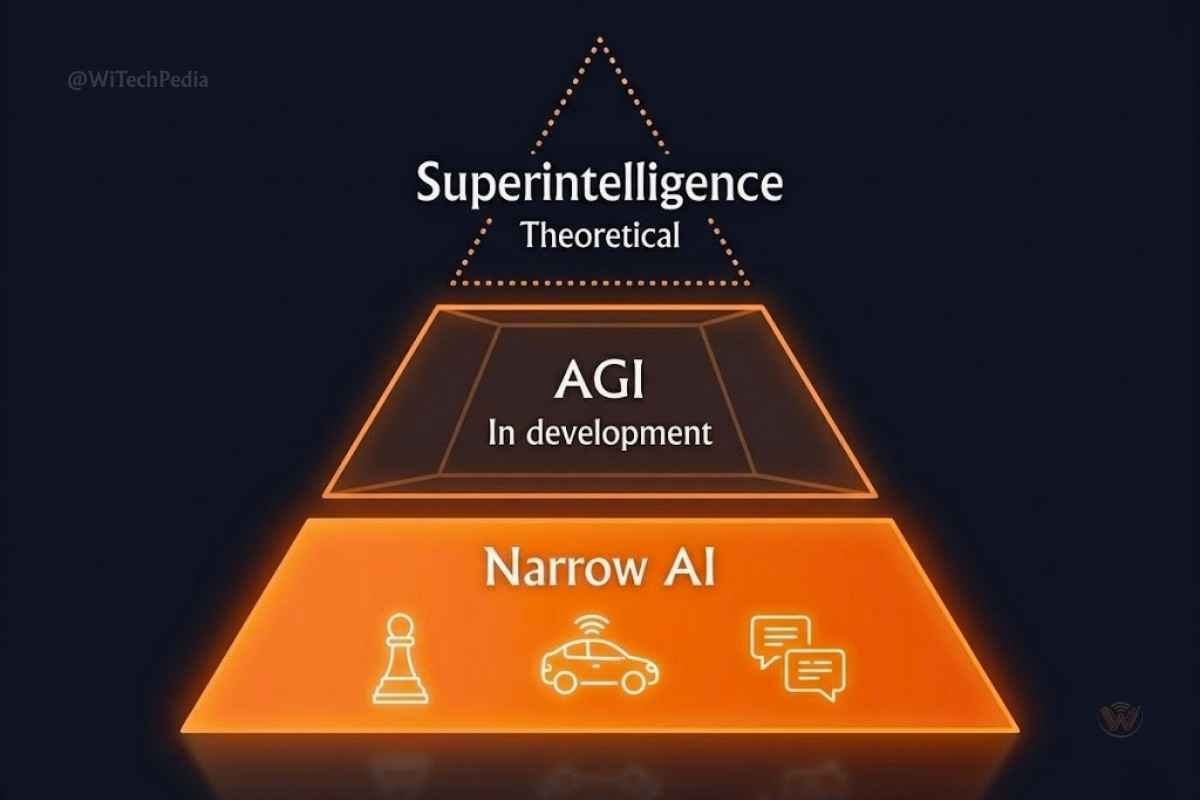
| Narrow AI | Weak AI | Designed for a single specific task | Exists today |
| General AI | AGI | Human-level reasoning across all domains | In development / debated |
| Superintelligence | ASI | Surpasses human intelligence in every field | Theoretical |
Every AI system you use today — from Siri to GPT-4o — is Narrow AI. It’s extraordinarily good at its task but completely blind to anything outside it. AGI, a machine with general human-like cognition, remains the holy grail of the field. Superintelligence is a theoretical future state that philosophers and safety researchers debate intensely.
By Functionality
- Reactive Machines — No memory. Responds to current inputs only. Example: Deep Blue (chess).
- Limited Memory AI — Uses past data to inform decisions. Example: Self-driving cars, recommendation engines.
- Theory of Mind AI — Understands human emotions, beliefs, and intentions. Partially emerging in advanced LLMs.
- Self-Aware AI — Possesses consciousness and subjective experience. Does not exist today.
How Does Artificial Intelligence Work?
This is where most explanations fail. Let’s be precise.
The Core Loop: Data → Algorithm → Model → Prediction
AI systems learn by finding patterns in data. Here’s the simplified pipeline:
- Data Collection — Vast datasets are gathered (text, images, audio, sensor readings).
- Preprocessing — Data is cleaned, labeled, and formatted.
- Model Training — An algorithm adjusts millions (or billions) of internal parameters to minimize prediction errors.
- Evaluation — The model is tested on unseen data to measure accuracy.
- Deployment — The trained model is embedded into a product or service.
- Feedback Loop — Real-world performance data refines future versions.
Machine Learning: The Engine of Modern AI
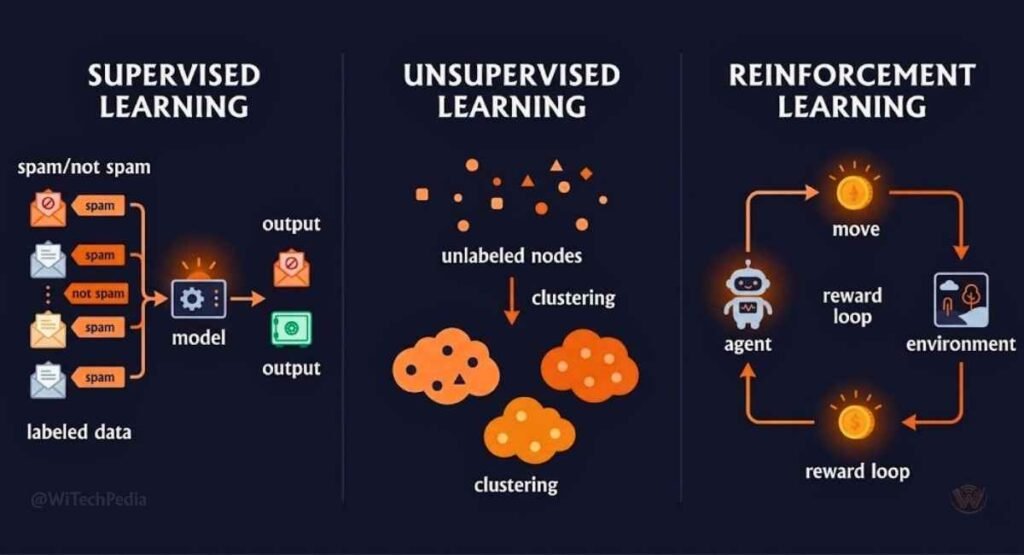
Machine learning (ML) is the dominant paradigm powering AI today. Rather than being explicitly programmed with rules, ML systems learn from examples.
There are three primary ML approaches:
- Supervised Learning — Trained on labeled data. A model sees 10,000 photos labeled “cat” or “dog” and learns to classify new images. Used in spam filters, medical imaging, fraud detection.
- Unsupervised Learning — No labels. The model finds hidden structure on its own. Used in customer segmentation, anomaly detection, recommendation systems.
- Reinforcement Learning (RL) — An agent learns by trial and error, receiving rewards for correct actions. Used in game-playing AI (AlphaGo, AlphaStar), robotics, and autonomous vehicles.
Deep Learning: The Neural Network Revolution
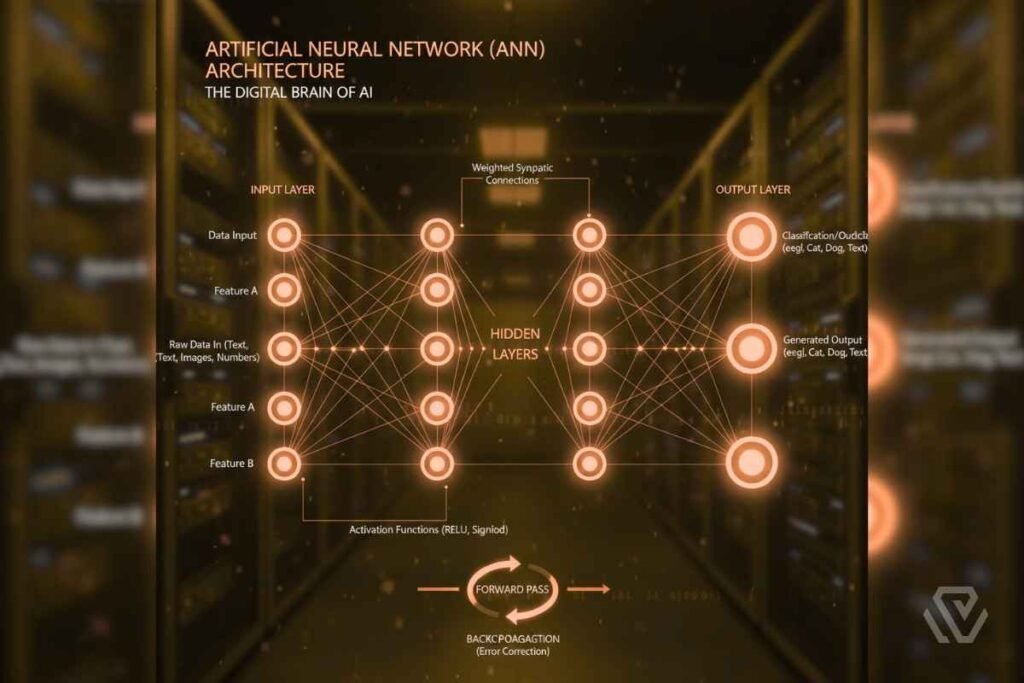
Deep learning is a subset of machine learning using layered artificial neural networks inspired by the human brain. Each “layer” learns increasingly abstract representations of data.
- A first layer might detect edges in an image.
- The next detects shapes.
- Deeper layers recognize objects, then scenes, then context.
This hierarchical feature learning is why deep learning dominates vision, speech, and language tasks — areas where hand-crafted rules fail completely.
Large Language Models (LLMs): AI That Speaks Human
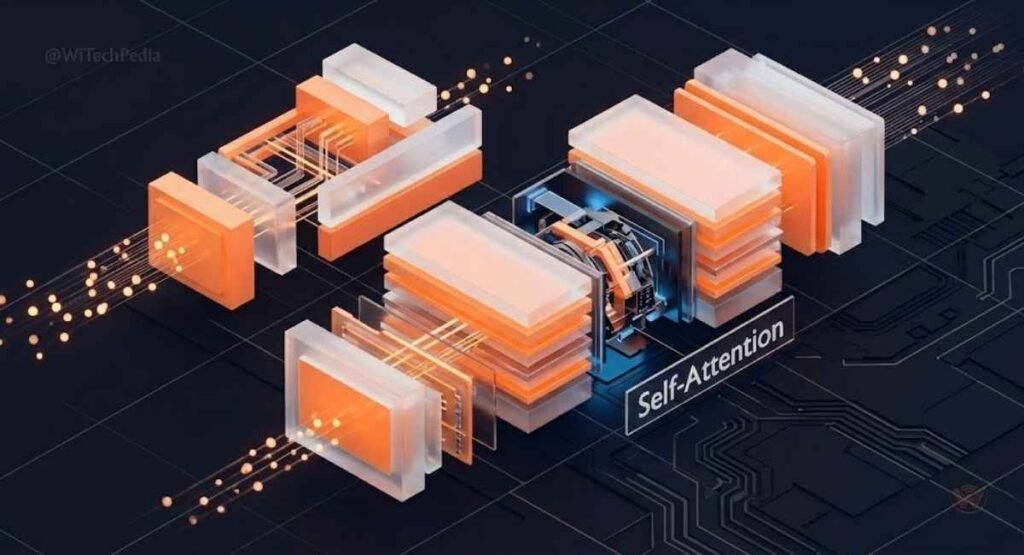
Modern conversational AI — ChatGPT, Claude, Gemini, Llama — is built on transformer architecture, introduced in Google’s landmark 2017 paper “Attention Is All You Need.”
Transformers process entire sequences simultaneously (not word-by-word) using a mechanism called self-attention, allowing models to understand long-range context in language. Scale this up with billions of parameters and trillions of tokens of training data, and you get systems capable of nuanced writing, reasoning, and code generation.
Key Branches of AI
Artificial Intelligence is an umbrella term covering several specialized disciplines:
Natural Language Processing (NLP)
Enables machines to understand, generate, and translate human language.
- Use cases: Chatbots, sentiment analysis, machine translation, text summarization, voice assistants.
- Examples: Google Translate, ChatGPT, Grammarly, Alexa.
Computer Vision
Gives machines the ability to interpret and understand visual information.
- Use cases: Facial recognition, medical image analysis, autonomous driving, quality inspection.
- Examples: Google Photos, Tesla Autopilot, Apple Face ID.
Robotics & Autonomous Systems
Combines AI with physical hardware to perform real-world tasks.
- Use cases: Warehouse automation, surgical robots, drone delivery, self-driving vehicles.
- Examples: Boston Dynamics robots, Amazon Kiva, Da Vinci Surgical System.
Expert Systems & Knowledge Graphs
Encodes domain expertise into rule-based or graph-structured systems.
- Use cases: Medical diagnosis, legal research, financial advisory.
- Examples: IBM Watson Health, Google Knowledge Graph.
Generative AI
Creates entirely new content — text, images, audio, video, code — from learned patterns.
- Use cases: Content creation, drug discovery, synthetic data generation, creative arts.
- Examples: DALL·E 3, Stable Diffusion, Sora, GitHub Copilot, Claude.
Real-World Applications of Artificial Intelligence
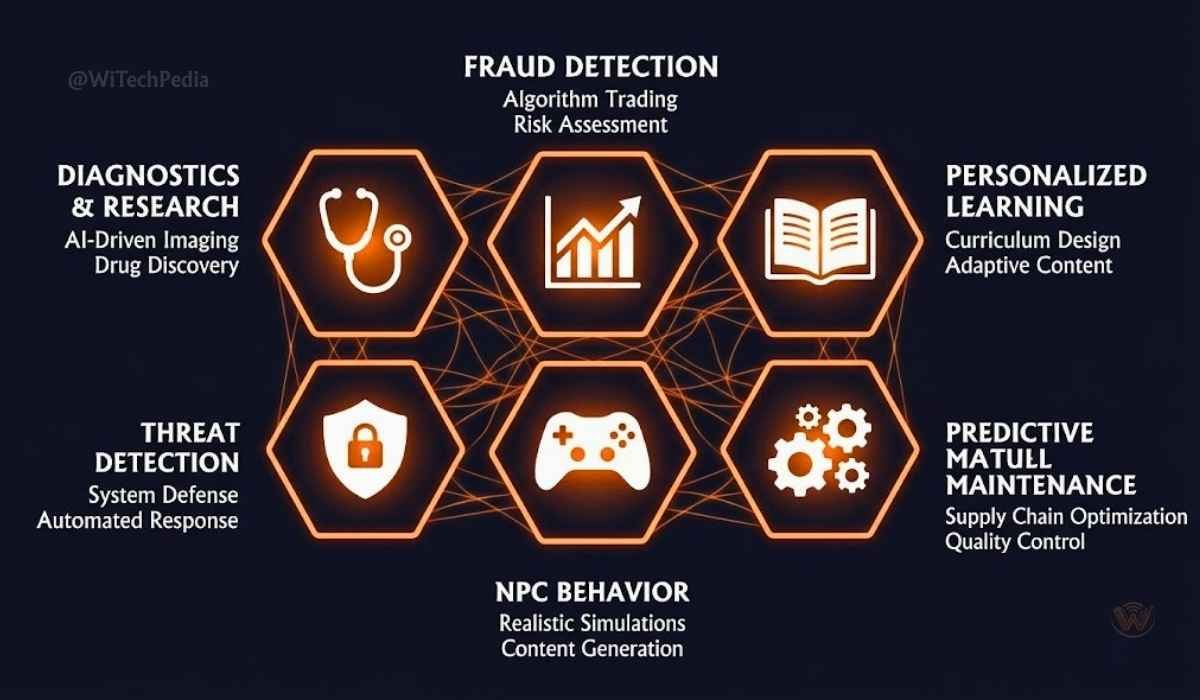
AI is not abstract — it’s embedded in systems billions of people touch daily.
Healthcare
- Diagnosis: Google DeepMind’s AlphaFold solved the 50-year protein-folding problem, accelerating drug discovery by decades.
- Radiology: AI models detect tumors in CT scans with accuracy matching senior radiologists.
- Drug Development: Generative AI models design novel drug candidates in hours vs. years.
- Administrative: NLP automates clinical documentation, freeing physicians from paperwork.
Finance
- Fraud Detection: AI flags anomalous transactions in milliseconds across billions of daily payments (Visa, Mastercard).
- Algorithmic Trading: Quant funds use RL agents to execute trades at superhuman speed.
- Credit Scoring: Alternative data models extend credit access to underserved populations.
Education
- Personalized Learning: Platforms like Khan Academy use AI to adapt difficulty in real time.
- AI Tutors: LLM-powered tutors provide 24/7 subject-matter assistance.
- Plagiarism & Assessment: Tools like Turnitin integrate AI detection alongside traditional checks.
Cybersecurity
- Threat Detection: ML models identify zero-day exploits and behavioral anomalies faster than any human analyst.
- Phishing Prevention: NLP classifiers filter malicious emails with near-zero false positives.
- Incident Response: AI orchestration tools automate triage and containment. (See also: WiTechPedia: Cybersecurity Fundamentals)
Gaming & Entertainment
- NPC Behavior: Reinforcement learning creates adaptive, unpredictable non-player characters.
- Procedural Generation: AI generates infinite worlds, quests, and dialogue (e.g., No Man’s Sky, AI Dungeon).
- Game Testing: AI agents log thousands of hours of automated QA in minutes. (See also: WiTechPedia: AI in Gaming)
Manufacturing & Supply Chain
- Predictive Maintenance: Sensor data + ML predicts equipment failure before it happens, saving billions.
- Quality Control: Computer vision systems detect defects at sub-millimeter precision.
- Logistics Optimization: AI routes delivery fleets and warehouse robots in real time (Amazon, DHL).
Major AI Models and Benchmarks (2024–2025)
The AI landscape moves fast. Here’s where the leading models stand:
| Model | Developer | Type | Strengths | Notable Benchmark |
|---|---|---|---|---|
| GPT-4o | OpenAI | Multimodal LLM | Text, vision, audio, speed | MMLU: ~87% |
| Claude 3.5 Sonnet | Anthropic | LLM | Reasoning, safety, coding | HumanEval: ~92% |
| Gemini 1.5 Pro | Google DeepMind | Multimodal LLM | Long context (1M tokens), vision | MMLU: ~85% |
| Llama 3.1 405B | Meta | Open-source LLM | Open weights, customization | Competitive with GPT-4 |
| Mistral Large | Mistral AI | LLM | Efficiency, European data sovereignty | Strong coding & reasoning |
| AlphaFold 3 | Google DeepMind | Scientific AI | Protein + molecular interaction prediction | Revolutionary in biology |
| Sora | OpenAI | Video generation | High-fidelity text-to-video | Industry-leading realism |
Editorial Insight: The most important trend of 2024–2025 is not raw benchmark performance — it’s multimodality and agentic behavior. Models that can see, hear, read, and act are fundamentally more useful than text-only systems, regardless of MMLU scores.
The Ethics and Risks of Artificial Intelligence
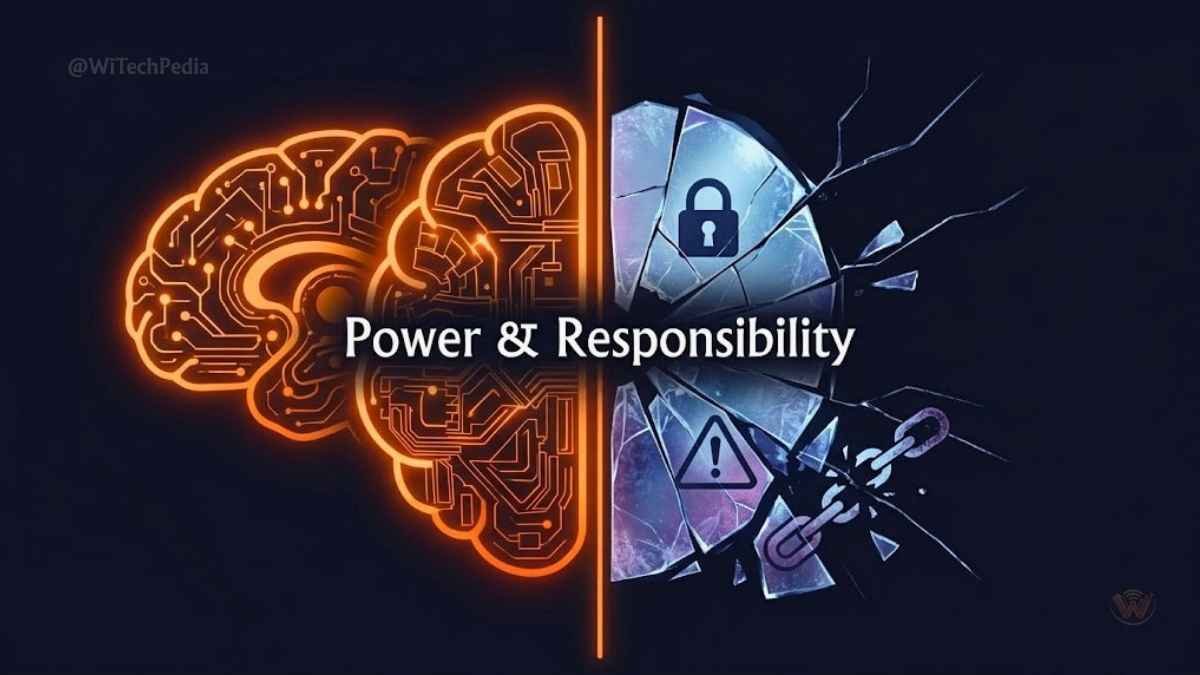
Power this transformative demands proportional responsibility.
Bias and Fairness
AI systems learn from historical data — and history carries human bias. Facial recognition systems have demonstrated significantly higher error rates for darker-skinned women (MIT Media Lab, Joy Buolamwini’s research). Hiring algorithms trained on historical decisions can perpetuate systemic exclusion. Addressing bias requires diverse training data, adversarial testing, and ongoing auditing.
Privacy and Surveillance
AI dramatically lowers the cost of mass surveillance. Facial recognition deployed in public spaces, voice assistants capturing ambient audio, and behavioral profiling at scale all challenge foundational privacy rights. The EU’s AI Act (2024) and emerging US frameworks represent early legislative responses.
Deepfakes and Misinformation
Generative AI can produce hyper-realistic synthetic media. The barrier to creating convincing fake video of any public figure is now near zero. This threatens electoral integrity, personal reputation, and public trust in media.
Job Displacement
The McKinsey Global Institute estimates that AI could automate 30% of current work activities by 2030. While history shows technology ultimately creates more jobs than it destroys, the transition period will be disruptive — particularly for routine cognitive and physical roles.
Existential Risk
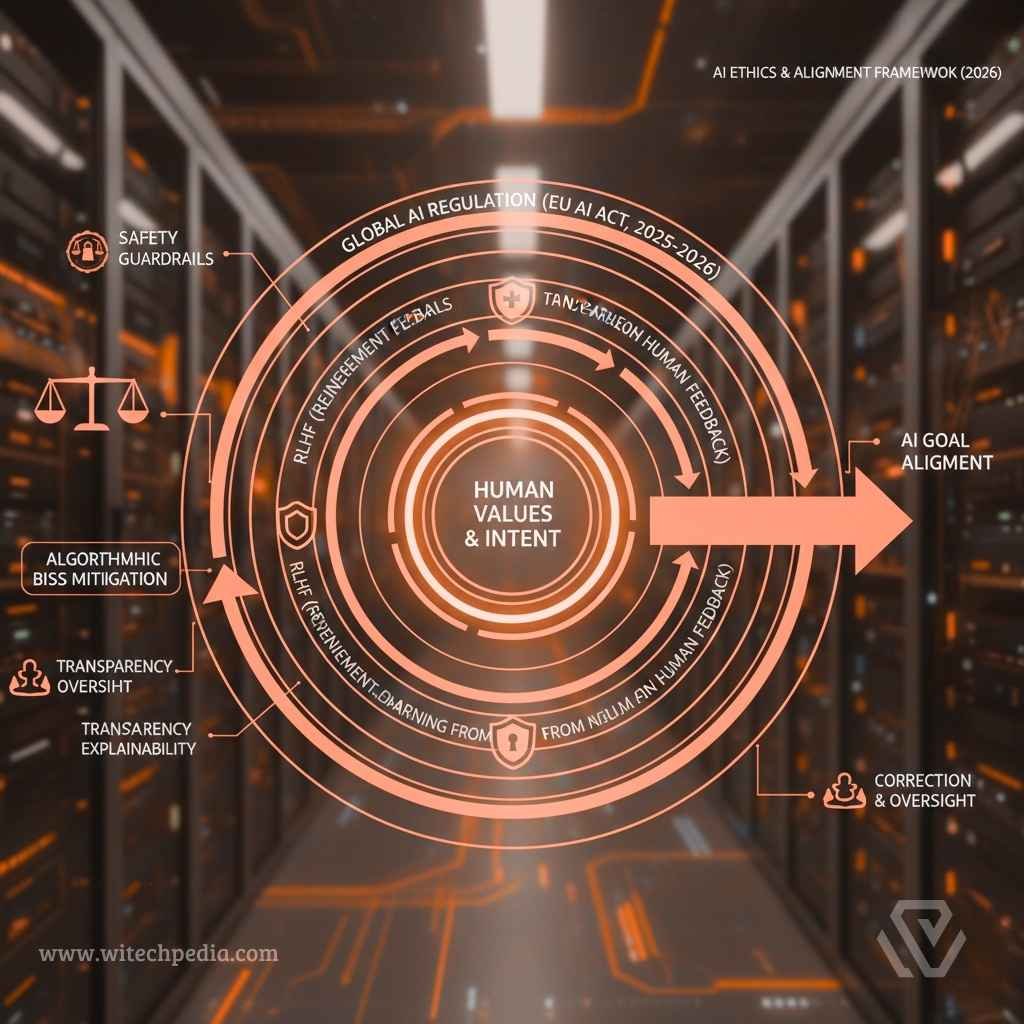
A minority but growing cohort of AI researchers — including Turing Award winners Geoffrey Hinton and Yoshua Bengio — have raised concerns about the long-term alignment problem: ensuring that future, more capable AI systems pursue goals aligned with human values. This remains a foundational challenge for the field.
AI Governance Landscape
| Framework | Region | Key Provisions |
|---|---|---|
| EU AI Act | European Union | Risk-based classification; bans on real-time biometric surveillance |
| AI Executive Order | United States | Safety testing requirements for frontier models |
| Hiroshima AI Process | G7 | Voluntary international norms for advanced AI |
| China AI Regulations | China | Mandatory content labeling; algorithm registration |
The Future of Artificial Intelligence

Agentic AI
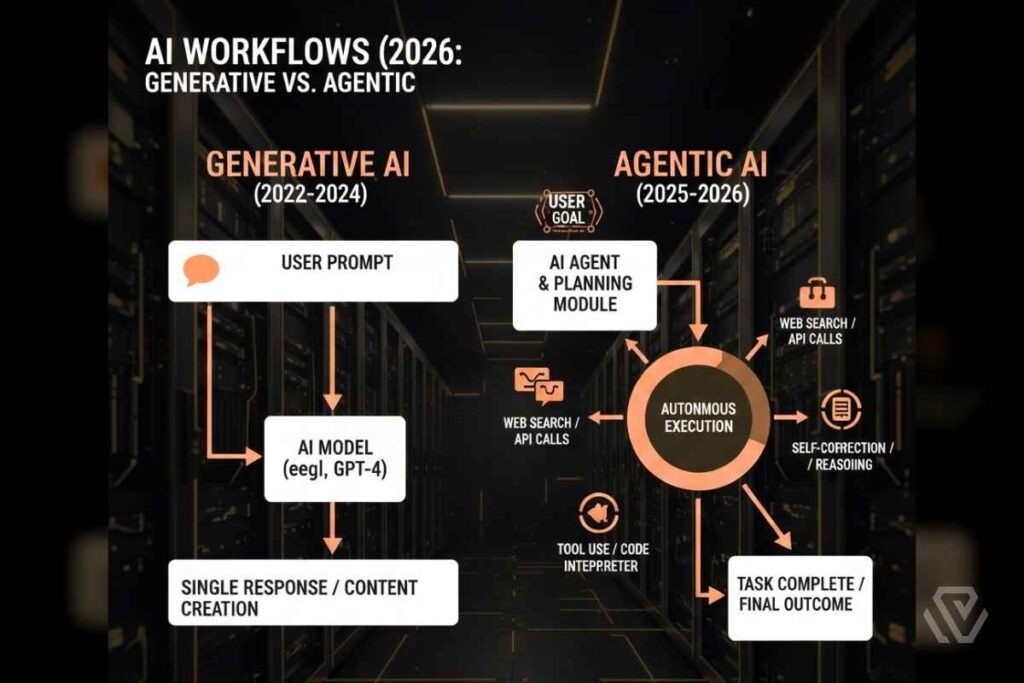
The next frontier is AI that doesn’t just respond — it acts. Agentic AI systems plan multi-step workflows, use tools, browse the web, write and execute code, and complete complex tasks autonomously. OpenAI’s Operator, Anthropic’s Claude with tool use, and Google’s Project Mariner are early examples of this paradigm shift.
AI + Robotics
Physical AI — embodied intelligence in machines that move through and manipulate the real world — is accelerating rapidly. Tesla Optimus, Figure AI’s humanoid robots, and Boston Dynamics’ systems represent a convergence of AI and robotics that could redefine labor.
Multimodal and Omni Models
Future AI will perceive and generate across all modalities simultaneously — text, image, audio, video, sensor data — with seamless context switching. GPT-4o and Gemini are early steps; true omni-models are emerging.
Scientific AI
AI is becoming a research tool of unprecedented power: designing new materials, discovering drugs, modeling climate systems, and even formulating mathematical proofs (DeepMind’s AlphaProof). We are entering an era where AI accelerates science itself.
Quantum AI
The intersection of quantum computing and AI could solve optimization problems currently intractable for classical hardware — opening new frontiers in drug discovery, cryptography, and logistics. (See also: The complete Quantum Computing guide)
Frequently Asked Questions (FAQ)
What is Artificial Intelligence in simple terms?
Artificial Intelligence is the ability of a computer system to perform tasks that normally require human thinking — like recognizing images, understanding speech, translating languages, or making decisions. Instead of being programmed with explicit rules, AI systems learn from large amounts of data to improve their performance over time.
What is the difference between AI, machine learning, and deep learning?
These three terms are nested: AI is the broadest concept (any system that mimics intelligence). Machine learning is a subset of AI where systems learn from data without being explicitly programmed. Deep learning is a subset of ML that uses multi-layered neural networks, enabling breakthroughs in image recognition, speech, and language tasks. Think of it as three concentric circles: AI > ML > Deep Learning.
Is Artificial General Intelligence (AGI) real yet?
No. As of 2025, no AGI system exists. All current AI — including the most advanced LLMs — is Narrow AI, excelling at specific tasks but incapable of general human-like reasoning across domains. The timeline for AGI is hotly debated, with estimates ranging from a few years to several decades, or possibly never.
How is AI used in everyday life?
AI is embedded in tools most people use daily: Google Search (ranking algorithms), YouTube and Netflix (recommendation engines), Gmail (spam filtering and Smart Reply), Siri/Alexa (voice assistants), Google Maps (route optimization), banking apps (fraud detection), and smartphone cameras (scene recognition and portrait mode). It’s invisible, ubiquitous infrastructure.
What are the biggest risks of Artificial Intelligence?
The most immediate risks include: algorithmic bias (systems perpetuating discrimination), privacy erosion (mass surveillance enabled by AI), deepfake misinformation, and job displacement. Longer-term concerns involve the challenge of aligning highly capable AI systems with human values — ensuring that advanced AI pursues goals that are genuinely beneficial. Responsible governance, transparency, and ongoing research in AI safety are essential responses.
What programming languages are used to build AI?
Python is the dominant language in AI/ML, with an unmatched ecosystem: TensorFlow, PyTorch, scikit-learn, Hugging Face Transformers, and LangChain. R is popular for statistical ML. Julia is emerging for high-performance scientific computing. C++ underpins many production inference engines for speed. For most practitioners, Python is the starting point and often the endpoint. You can check out Best Programming Languages for AI Development guide for better understanding.
Conclusion: Why Artificial Intelligence Is the Defining Technology of Our Era
Artificial Intelligence is not a trend. It’s a transformation.
In the span of a few decades, AI has moved from academic theory to the invisible infrastructure of modern life. It accelerates scientific discovery, powers the devices in our pockets, guards financial systems, and is beginning to reshape every profession on earth.
Here are the five key takeaways from this guide:
- AI learns from data — not programmed rules. Its power comes from finding patterns at a scale no human brain can match.
- All AI today is Narrow AI — extraordinarily capable within a domain, but not general human-level intelligence.
- Deep learning and transformer models are the engines behind the current AI revolution — from image recognition to LLMs.
- Real-world AI is already everywhere — healthcare, finance, cybersecurity, gaming, and logistics are being fundamentally reshaped.
- Ethics, safety, and governance matter enormously — the technology’s trajectory is not inevitable; it’s shaped by the choices humans make today.
We are living through the most consequential technological inflection point since the internet. Understanding AI isn’t optional anymore — it’s foundational literacy for the 21st century.
Stay ahead of AI’s rapid evolution. Subscribe to the WiTechPedia newsletter for weekly deep-dives on emerging technologies — no jargon, no hype, just clarity.