









The landscape of artificial intelligence evolves faster than any other tech sector. If you want to build the next generation of neural networks or autonomous agents, choosing the best languages for AI development in 2026 is your first critical decision. While one language has dominated for a decade, the rise of Large Language Models (LLMs) and Edge AI is shifting the ground. You need a language that balances developer speed with raw execution power.
The Best Languages for AI Development : Quick Comparison
Before we dive deep, here is a snapshot of the current AI landscape.
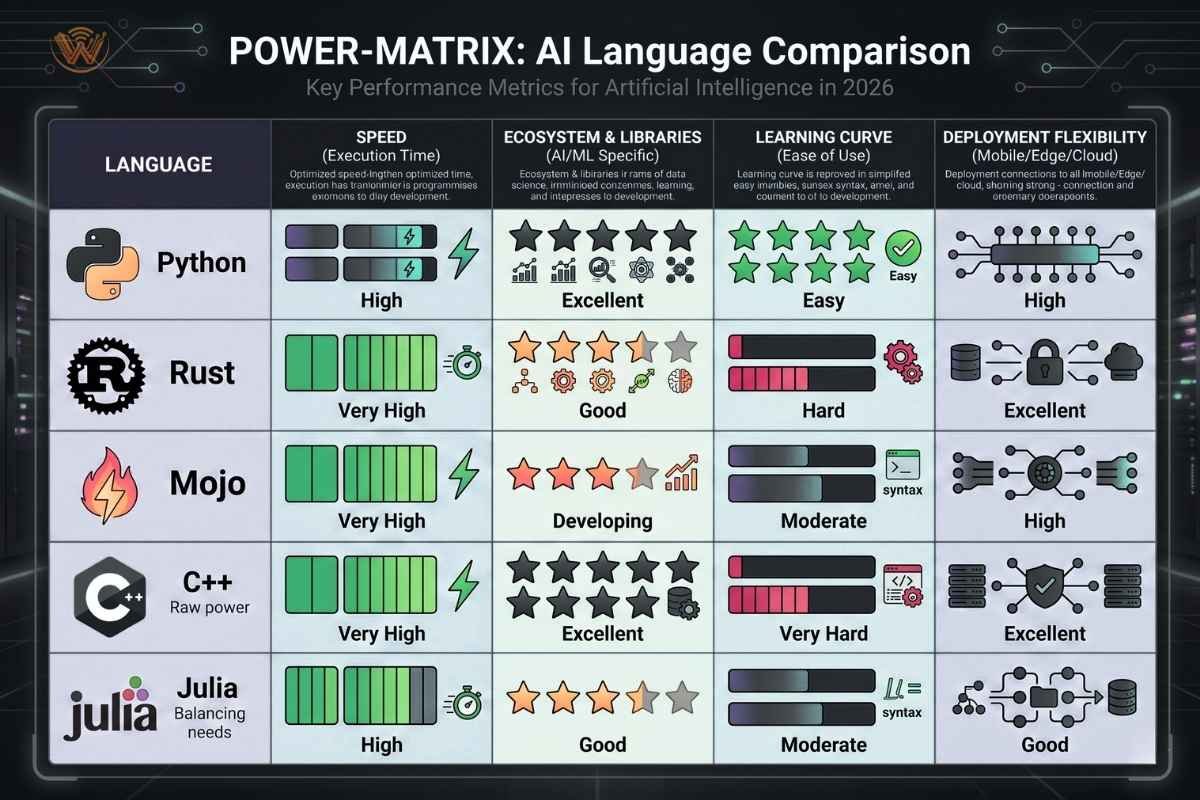
| Languages | Execution Speed | Ecosystem | Learning Curve | Primary AI Use Case |
|---|---|---|---|---|
| Python | Slow | Massive | Easy | Prototyping & Research |
| Rust | Blazing Fast | Growing | Hard | AI Kernels & Safety |
| Mojo | Extreme Fast | New | Medium | High-Performance AI |
| C++ | Very Fast | Mature | Hard | Inference & Embedded AI |
| Julia | Fast | Niche | Medium | Mathematical Modeling |
1. Python: The Eternal Glue of AI
Python remains the most popular choice for AI. It acts as the “glue” that connects complex C++ libraries to a simple interface. You can consider it one of the best languages for AI development.
Why it still wins in 2026:
The Downside:
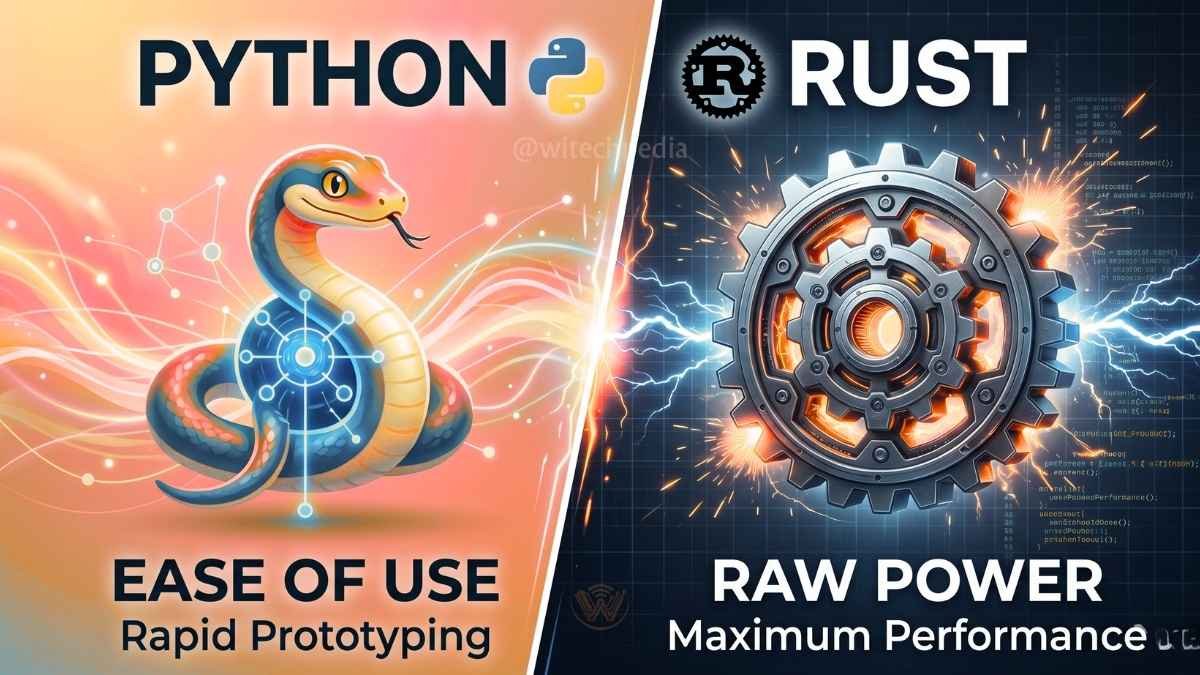
2. Rust: The New Standard for AI Infrastructure
Rust is no longer just for systems programming. It is now essential for AI infrastructure.
Why Rust is surging:
If you build high-frequency trading AI or real-time robotics, Rust is your best bet.
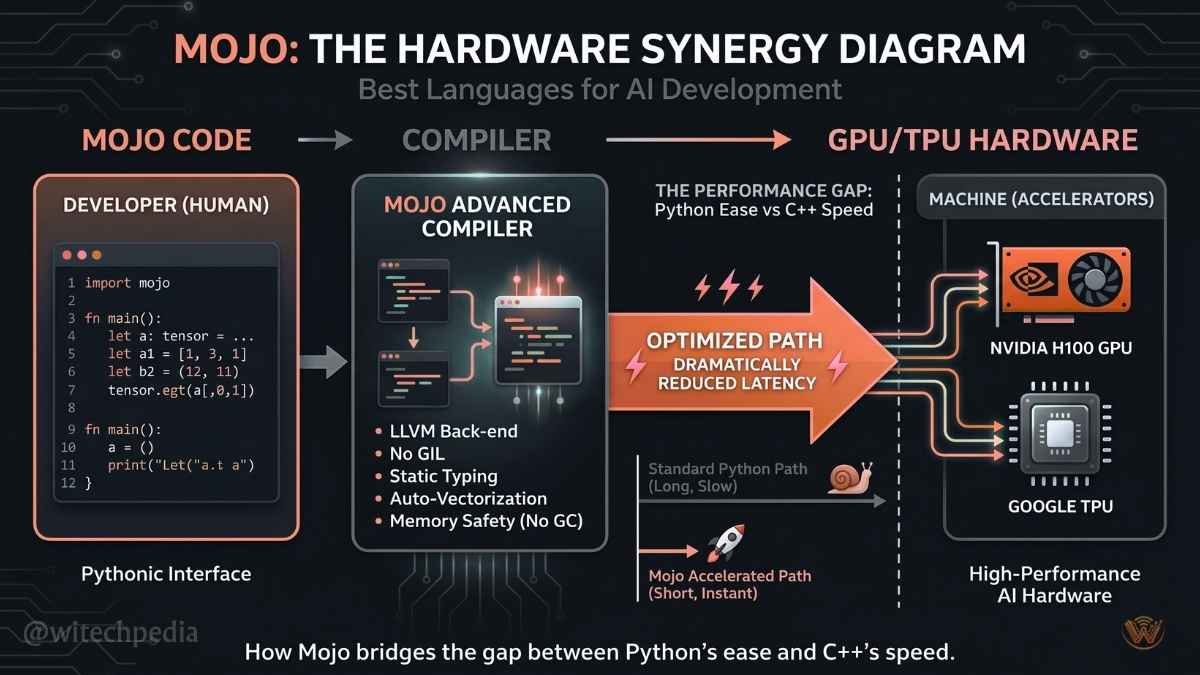
3. Mojo: The Python-Compatible Powerhouse
Mojo is the most exciting newcomer. It aims to combine the syntax of Python with the performance of C++.
The Mojo Advantage:
4. C++: The Engine Under the Hood
Almost every major AI framework is actually written in C++. When you run a Python command, C++ does the heavy lifting.
Key Strengths:
5. Julia: The Mathematician’s Dream
Julia was built specifically for scientific computing. It solves the “two-language problem” by being as easy as Python but as fast as C.
Which Language Should You Choose?
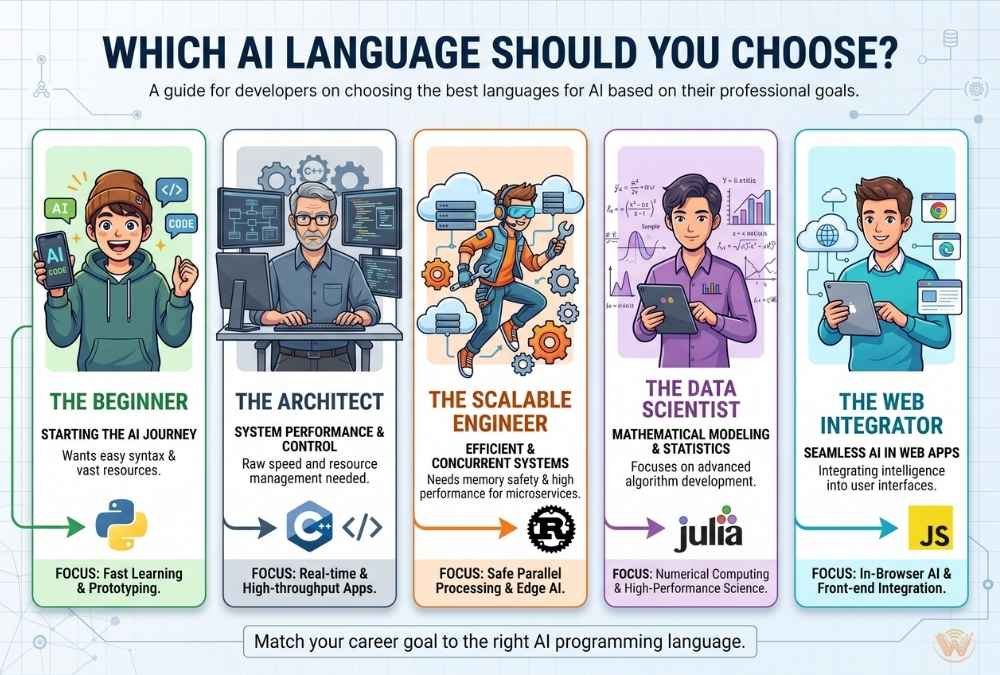
The best languages for AI Development depends on your specific goal in 2026:
Frequently Asked Questions (FAQs)
Is Python still relevant for AI in 2026?
Yes. Python is still the primary language for AI research and LLM orchestration. However, developers now combine it with Rust or Mojo for performance.
Should I learn Rust if I already know Python?
Absolutely. Rust allows you to write the “fast parts” of your AI application. This combination makes you a top-tier AI engineer.
What is Mojo and why does it matter?
Mojo is a new language that looks like Python but runs as fast as C. It solves the performance bottleneck of AI development.
Which language is best for building AI Agents?
Python is currently the best because of its massive library support for LLMs and API integrations.
Do I need to learn C++ for Machine Learning?
You don’t need it for basic ML, but you do need it if you want to optimize AI models for mobile devices or specialized hardware.
Final Thoughts
The era of “one language fits all” is over. In 2026, the most successful AI developers use a multi-language stack. You use Python for flexibility, Rust for safety, and C++ or Mojo for raw power.
Ready to optimize your workflow?
Check out our guide on the best productivity tools in 2026 to manage your learning journey. If you are new to coding, explore our Programming and DevOps to start your journey today!