











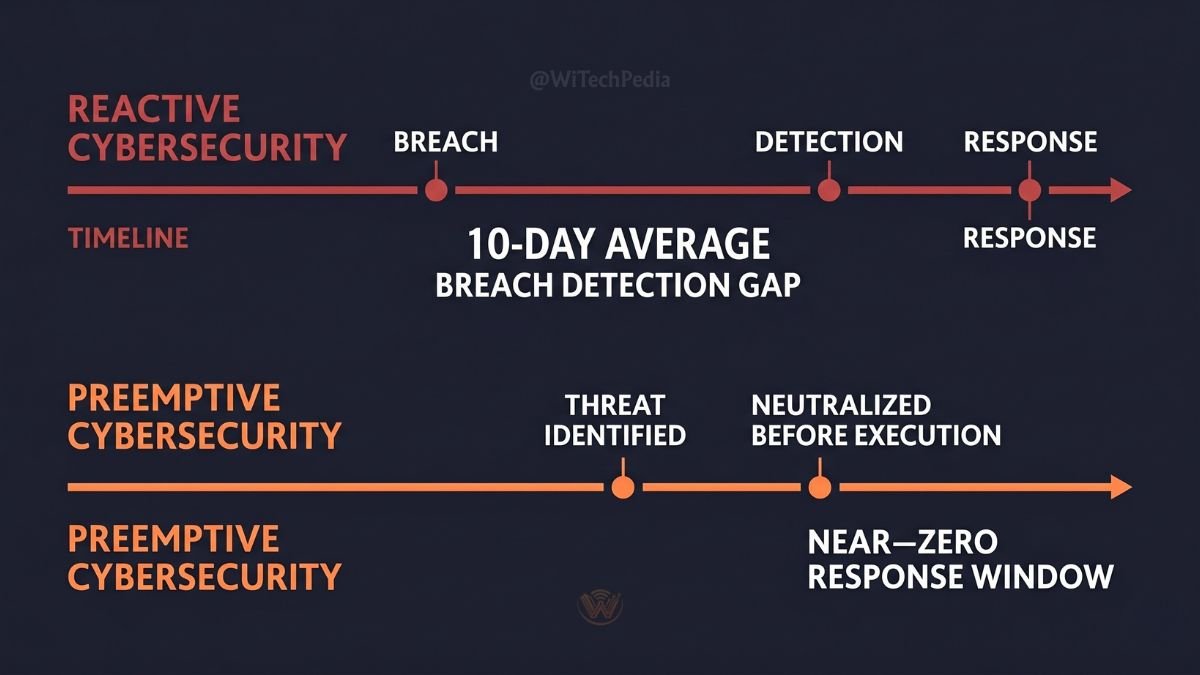
In 2024, 87% of cyber incidents involved AI-driven attack techniques — and organizations took an average of ten days to even realize they had been compromised. Ten days. In that window, attackers move laterally, exfiltrate data, and entrench themselves deeper than most security teams can ever fully unwind.
- What Is Preemptive Cybersecurity?
- The Strategic Shift: From Reactive to Preemptive Defense
- The Core Framework: Deny, Deceive, Disrupt
- Key Technologies Powering Preemptive Cybersecurity
- Preemptive vs. Reactive Cybersecurity: A Direct Comparison
- Real-World Use Cases
- How to Implement a Preemptive Cybersecurity Strategy
- Challenges to Adoption
- FAQ: Preemptive Cybersecurity
- The Bottom Line: Don’t Wait to Be Attacked
The era of waiting for alarms to fire is over.
Preemptive cybersecurity is the answer — a fundamentally different philosophy that shifts the entire posture of digital defense from reactive firefighting to strategic, intelligence-led prevention. This guide breaks down exactly what it is, how it works, which tools power it, and how your organization can start the transition today.
What Is Preemptive Cybersecurity?
Preemptive cybersecurity is the practice of identifying and neutralizing threats before they can be executed — not after a breach is detected. Rather than waiting for an attacker to trigger a security alert, preemptive strategies focus on removing attack vectors, deceiving adversaries, and disrupting the kill chain at its earliest possible stage.
Gartner formally defines preemptive cyber defense as:
“An emerging trend and related set of technologies that are focused on proactively deflecting and defending against cyber threats by identifying and mitigating likely attack vectors and related vulnerabilities and exposures before they can be exploited.”
This is more than a technology upgrade. It is a strategic mindset shift — from “detect and respond” to “deny, deceive, and disrupt.”
Why Traditional Security Is Failing
Legacy security architectures were built for a slower threat environment. Detection and response (DR) models made sense when attack cycles were measured in weeks. Today:
- AI-powered threats move in seconds, not days.
- Threat actors research and rehearse attacks before striking, mapping your vulnerabilities long before you know they’re watching.
- Ransomware, advanced persistent threats (APTs), and supply chain attacks are designed to evade signature-based detection entirely.
The problem isn’t effort — it’s timing. You cannot win a race you start ten days late.
The Strategic Shift: From Reactive to Preemptive Defense
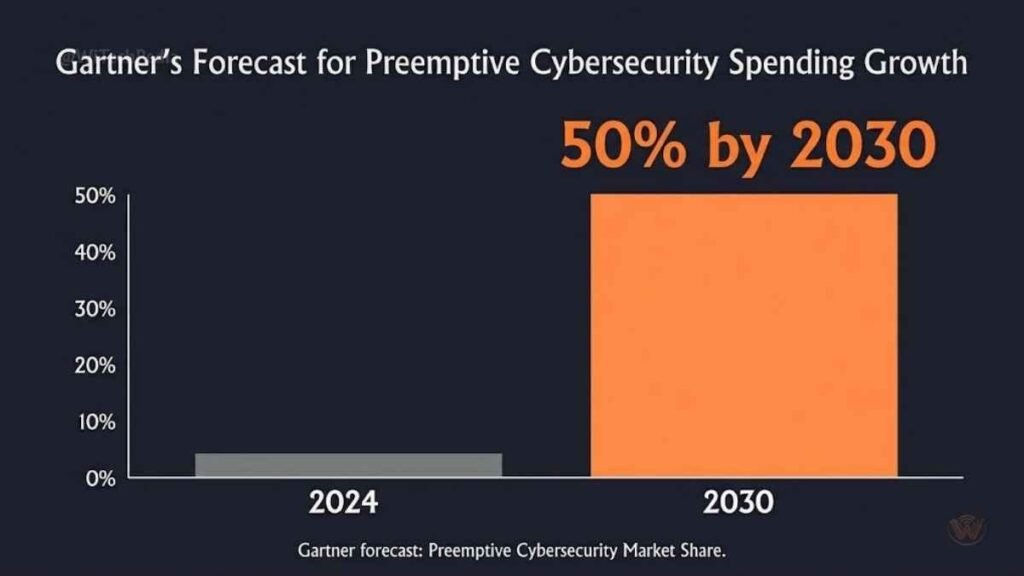
The cybersecurity industry is undergoing a profound reorientation. According to Gartner, by 2030, preemptive cybersecurity solutions will account for 50% of IT security spending, up from less than 5% in 2024. By 2028, an estimated 35% of cybersecurity solutions will incorporate some form of preemptive capability.
This is not incremental evolution. It is a paradigm change — one driven by three converging forces:
- The AI arms race: Adversaries now use generative AI to discover vulnerabilities, craft phishing lures, and automate exploitation at a scale no human SOC team can match manually.
- Attack surface explosion: Cloud sprawl, IoT proliferation, and remote work have created an attack surface that reactive tools simply cannot cover.
- The cost of failure: The average cost of a data breach reached $4.88 million in 2024 (IBM). Prevention is always cheaper than remediation.
The Core Framework: Deny, Deceive, Disrupt
The operational heart of preemptive cybersecurity rests on a three-pillar framework — often described as the “3 D’s”:
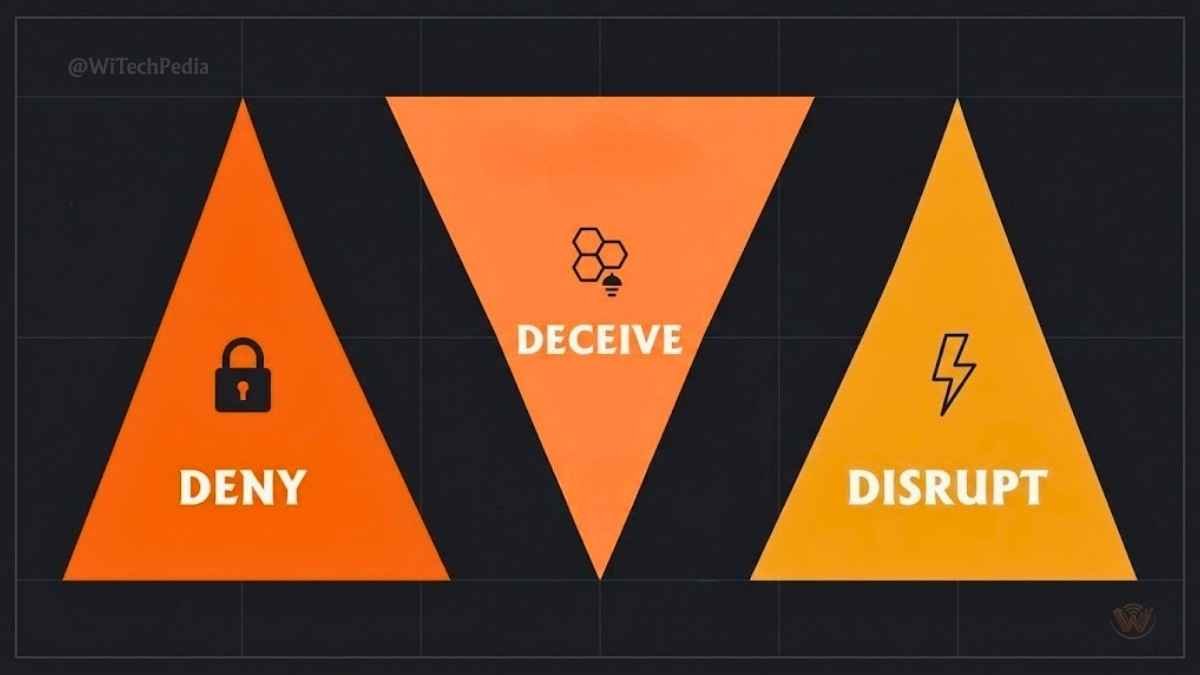
1. Deny — Remove the Attack Surface
The first pillar focuses on exposure management: systematically identifying, mapping, and eliminating vulnerabilities before attackers can exploit them.
This includes:
- Continuous Attack Surface Management (CASM) — automated discovery of all exposed assets, shadow IT, and misconfigured services.
- Vulnerability prioritization — using AI to rank vulnerabilities not just by CVSS score but by actual exploitability and business asset value.
- Zero Trust Architecture — removing implicit trust from every user, device, and network segment so that attackers who penetrate the perimeter find nothing automatically accessible.
- Obfuscation technologies — making systems invisible or unreadable to unauthorized access, even for attackers already inside the network.
2. Deceive — Make Attackers Waste Time and Reveal Themselves
The second pillar deploys deception technology — creating cyber minefields of realistic-looking fake assets (honeypots, honeynets, decoy credentials) that lure attackers away from real targets.
When an attacker engages a decoy:
- Their TTPs (Tactics, Techniques, and Procedures) are captured in real time.
- The security team gains early warning before any real damage occurs.
- Threat intelligence is enriched with fresh, environment-specific adversary data.
Modern deception platforms go far beyond static honeypots. Automated Moving Target Defense (AMTD) dynamically shifts the attack surface — randomizing network configurations, endpoint identities, and data locations to ensure attackers are perpetually off-balance.
3. Disrupt — Break the Kill Chain Early
The third pillar uses predictive intelligence to interrupt attack sequences before they reach their target. This leverages:
- Threat intelligence feeds — correlating global attack data to recognize early indicators of compromise (IoCs) specific to your industry or technology stack.
- Simulation Digital Twins — virtual replicas of your environment where AI models simulate how threat actors would actually move through your systems, surfacing weaknesses before attackers find them.
- Autonomous purple teaming — continuous, AI-driven red team/blue team exercises that test defenses without disrupting live production systems.
Key Technologies Powering Preemptive Cybersecurity
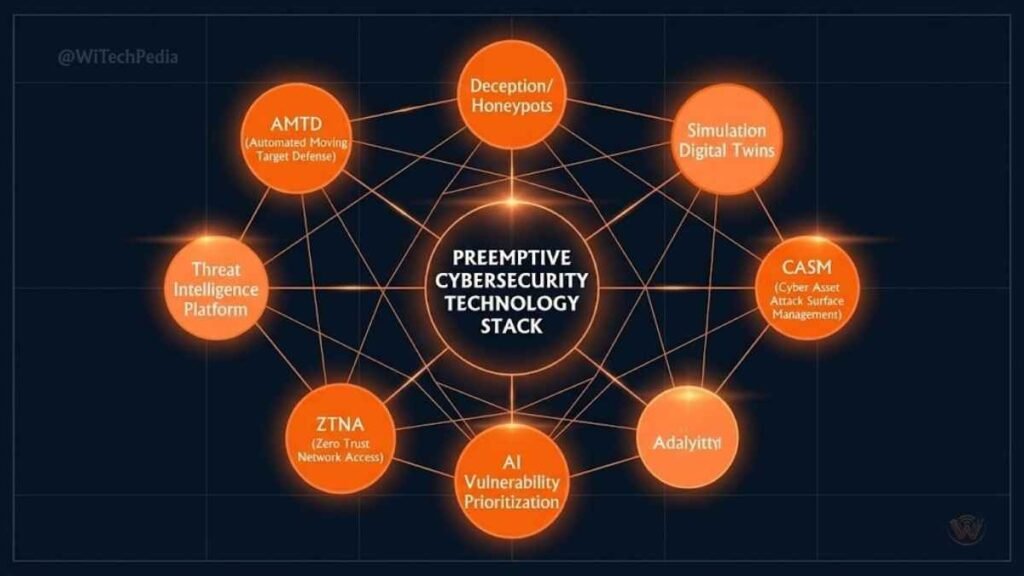
| Technology | Core Function | Best Use Case |
|---|---|---|
| AMTD (Automated Moving Target Defense) | Dynamically shifts attack surfaces to confuse adversaries | Protecting cloud-native and hybrid environments |
| Deception Technology / Honeypots | Lures attackers into fake systems, captures TTPs | Threat intelligence gathering, early breach detection |
| Simulation Digital Twins | Models attack paths in a virtual copy of your environment | Pre-deployment security validation, red team simulation |
| Continuous Attack Surface Management (CASM) | Discovers and maps all exposed assets in real time | External-facing cloud assets, shadow IT, API security |
| AI-Driven Vulnerability Prioritization | Ranks vulnerabilities by exploitability + business impact | Helping under-resourced teams focus patching effort |
| Zero Trust Network Access (ZTNA) | Enforces least-privilege access across all users/devices | Remote workforce, multi-cloud access control |
| Threat Intelligence Platforms (TIP) | Aggregates and contextualizes global threat data | SOC enrichment, proactive IOC blocking |
Preemptive vs. Reactive Cybersecurity: A Direct Comparison
| Dimension | Reactive Security | Preemptive Cybersecurity |
|---|---|---|
| Posture | Detect and respond after the fact | Deny, deceive, and disrupt before impact |
| Timing | Responds after breach occurs | Acts before attack executes |
| Primary Tools | EDR, SIEM, IDS/IPS, forensics | AMTD, deception tech, digital twins, CASM |
| AI Role | Alert triage, anomaly detection | Predictive modeling, autonomous simulation |
| Attack Surface | Static; perimeter-focused | Dynamic; continuously shifting |
| Cost Model | High remediation + incident costs | Higher upfront investment, lower breach costs |
| Alignment with AI Threats | Struggles with novel, AI-generated attacks | Designed for AI-speed adversaries |
| Gartner Trajectory | Declining priority by 2030 | 50% of IT security spend by 2030 |
Real-World Use Cases
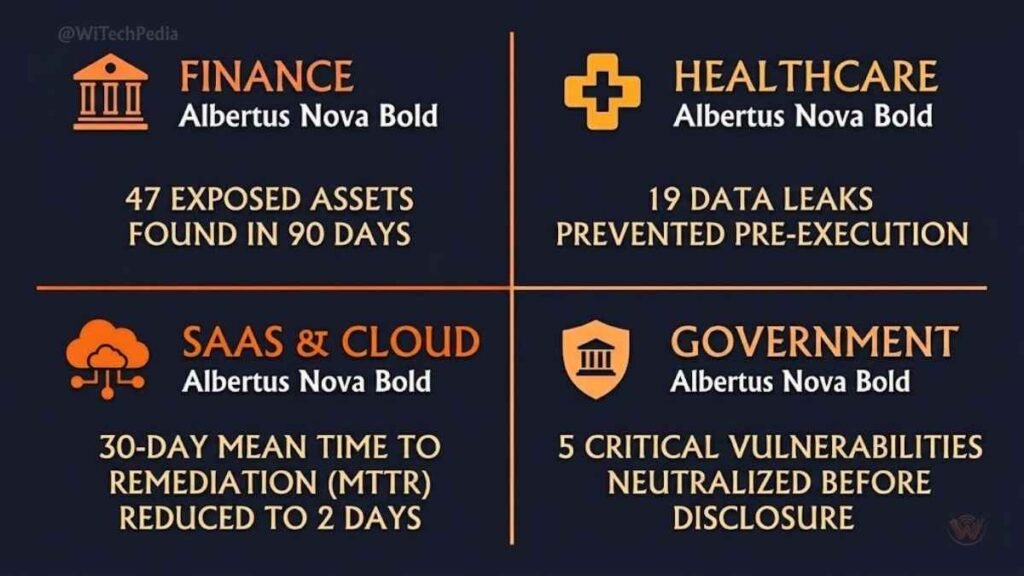
Enterprise: Protecting Financial Services
A major bank deployed continuous attack surface management alongside AMTD across its hybrid cloud environment. Within 90 days, the security team identified 47 previously unknown exposed assets and reduced mean time to vulnerability remediation by 62%. Deception layers captured two attempted lateral movement campaigns, providing threat intelligence that updated defenses organization-wide before any breach occurred.
Healthcare: Securing Patient Data at Scale
A regional hospital network facing a surge in ransomware targeting healthcare providers deployed a simulation digital twin environment. By running autonomous attack simulations against the virtual replica, the security team discovered a misconfigured Active Directory path that would have allowed full domain compromise. The issue was patched before any real-world attacker reached it.
SaaS Startup: Zero Trust From Day One
A cloud-native SaaS company building AI-powered analytics tools embedded zero trust network access and API threat modeling into its CI/CD pipeline from the start. Every new feature release is subjected to automated adversarial simulation before deployment. The result: zero critical incidents in 18 months despite operating in a high-value, high-target sector.
Government: Supply Chain Defense
A government agency responsible for critical infrastructure adopted threat intelligence platforms integrated with simulation digital twins to map supply chain attack vectors. The proactive model identified three third-party vendors with critical unpatched vulnerabilities — all before any of those vendors were exploited in real-world campaigns against peer agencies.
How to Implement a Preemptive Cybersecurity Strategy
Transitioning from reactive to preemptive security doesn’t happen overnight, but these steps create a clear path forward:
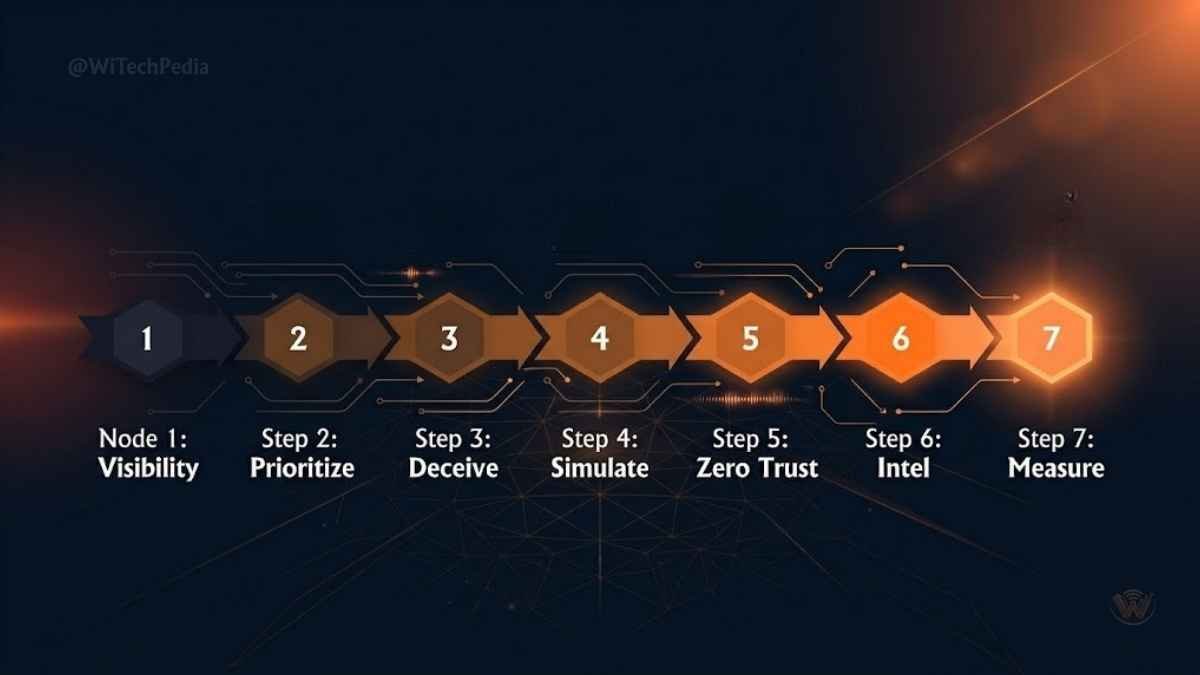
Step 1: Achieve Full Asset Visibility
You cannot protect what you cannot see. Deploy continuous attack surface management to build a living inventory of every external-facing asset — including cloud services, APIs, shadow IT, and third-party integrations.
Step 2: Prioritize Exposures by Business Risk
You may also like

Not all vulnerabilities are equal. Use AI-driven prioritization tools to rank exposures by the combination of exploitability, asset criticality, and potential business impact — not just severity scores.
Step 3: Deploy Deception Layers
Introduce honeypots and decoy assets into your environment. These cost relatively little to deploy and deliver outsized intelligence value: every attacker interaction tells you exactly what adversaries are targeting and how they operate.
Step 4: Simulate Before You Suffer
Implement simulation digital twins or autonomous purple team exercises to continuously test your defenses in a safe, non-production environment. Run these cycles monthly at minimum.
Step 5: Enforce Zero Trust Across the Board
Eliminate implicit trust from every network segment, user account, and device. Adopt least-privilege access principles and deploy ZTNA solutions that adapt dynamically to user behavior and context.
Step 6: Integrate Threat Intelligence
Connect global threat intelligence feeds directly into your security stack. Ensure your SOC team can act on threat data in near-real time — not just in weekly review meetings.
Step 7: Measure and Iterate
Preemptive cybersecurity is not a one-time deployment. Track KPIs like mean time to detect (MTTD), attack surface reduction rate, deception engagement rate, and simulation coverage. Iterate continuously.
Challenges to Adoption
Preemptive security is compelling — but the transition isn’t without friction. Leaders should anticipate:
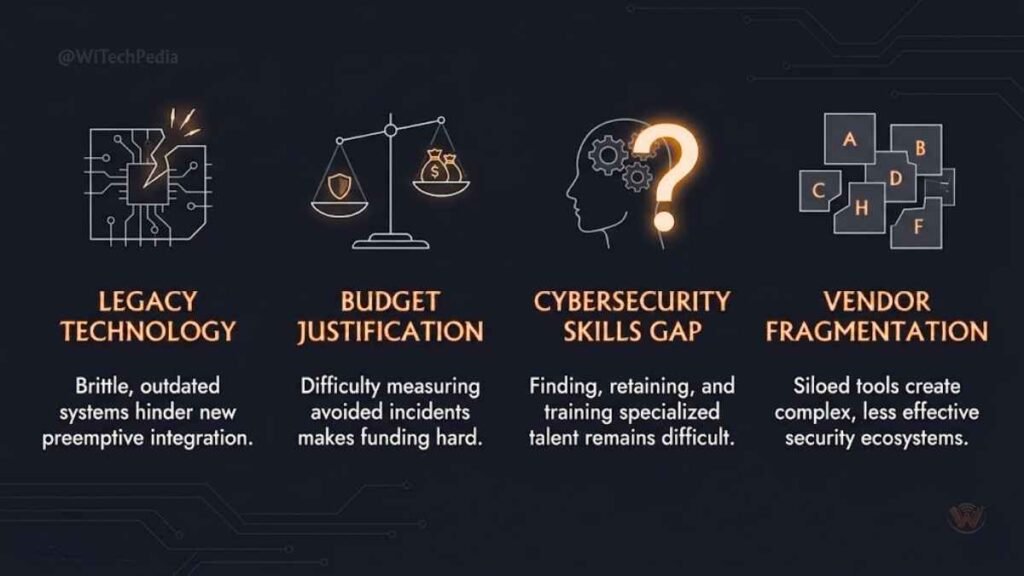
- Legacy technology debt: Many organizations carry detection-and-response stacks built over years. Integrating preemptive tools without disrupting existing workflows requires careful architecture planning.
- Budget justification: Preventing an attack that never visibly happened is harder to quantify than responding to one that did. Building a business case requires clear ROI frameworks tied to breach cost avoidance.
- Skills gap: Preemptive strategies require expertise in threat intelligence, adversary simulation, and AI-driven security tooling — skills in short supply across the industry.
- Vendor fragmentation: The market is still maturing. Many vendors claim “preemptive” capabilities without meeting Gartner’s formal definition. Due diligence is essential.
FAQ: Preemptive Cybersecurity
What is the difference between preemptive cybersecurity and proactive cybersecurity?
The terms are closely related but have a meaningful distinction. Proactive cybersecurity is a broad philosophy of taking initiative — patching vulnerabilities, training staff, and hardening systems before incidents occur. Preemptive cybersecurity is a more specific, technology-driven approach that actively anticipates, models, and neutralizes specific attack vectors before they are executed — often using AI, simulation, and deception. Preemptive is a subset and evolution of the proactive mindset.
How does preemptive cybersecurity use artificial intelligence?
AI powers several critical functions in preemptive security: predictive threat modeling that identifies attack paths based on historical patterns, autonomous vulnerability prioritization that ranks exposures by exploitability and business risk, simulation digital twins that model adversary behavior in virtual environments, and continuous anomaly detection that flags deviations from behavioral baselines before they become incidents. AI effectively amplifies the speed and accuracy at which preemptive strategies operate.
Is preemptive cybersecurity suitable for small and medium businesses (SMBs)?
Yes, though the approach scales with resources. SMBs can start with cloud-based attack surface management tools and managed threat intelligence feeds — both of which are increasingly affordable as SaaS offerings. Zero trust principles can be implemented incrementally. The key is prioritizing the highest-impact changes (full asset visibility + privilege reduction) before deploying more sophisticated deception or simulation technologies.
What is Automated Moving Target Defense (AMTD) and why does it matter?
AMTD is a preemptive security technique that continuously randomizes and shifts an organization’s attack surface — changing system identities, network configurations, and data locations — to ensure that any reconnaissance data gathered by an attacker quickly becomes obsolete. This fundamentally undermines the intelligence-gathering phase that precedes most sophisticated attacks. Gartner has identified AMTD as one of the defining emerging technologies within the preemptive cybersecurity trend.
How much does implementing preemptive cybersecurity cost?
Costs vary significantly depending on organizational size and scope. Entry-level implementations (basic CASM tools + zero trust policies) can begin in the range of $20,000–$100,000 annually for mid-size organizations. Enterprise-grade stacks incorporating digital twins, deception platforms, and autonomous simulation can run well beyond $500,000 annually. However, context matters: with the average cost of a data breach at $4.88 million in 2024, even moderate investments in preemptive security deliver significant ROI through breach cost avoidance alone.
What does Gartner say about the future of preemptive cybersecurity?
Gartner has made preemptive cybersecurity a top strategic technology trend. Its projections: by 2030, preemptive solutions will account for 50% of IT security spending (up from under 5% in 2024), 75% of security solutions currently focused solely on detection and response will integrate preemptive capabilities, and preemptive approaches will become the primary strategy for defending against AI-generated attack surfaces. Gartner has also stated: “In the age of GenAI, preemptive capabilities — not detection and response — are the future of cybersecurity.”
The Bottom Line: Don’t Wait to Be Attacked
Preemptive cybersecurity is not a niche concept for enterprise giants. It is the direction the entire industry is moving — driven by the inescapable reality that reactive defenses cannot keep pace with AI-powered adversaries operating at machine speed.
Here are the key takeaways to carry forward:
- The timing problem is existential. A ten-day average detection gap is an eternity in modern threat environments. Preemptive strategies eliminate the gap by acting before exploitation, not after.
- The 3 D’s framework is your foundation. Deny attack vectors through exposure management. Deceive adversaries with realistic decoys. Disrupt kill chains using predictive intelligence and simulation.
- AI is both the threat and the solution. The same AI capabilities enabling sophisticated attacks can power your defenses — through autonomous simulation, predictive modeling, and dynamic surface obfuscation.
- Start where you are. Full transformation takes time. But full asset visibility and zero trust principles can be implemented now, at any organizational size.
- The cost equation is clear. Preemptive investment is not an expense — it is insurance with a quantifiable return measured against the millions lost to each breach.
The organizations that will emerge from the next decade of cyber conflict as resilient and trusted will not be the ones who responded fastest. They will be the ones who made themselves the hardest targets to reach in the first place.
📬 Stay Ahead of the Threat Curve
Subscribe to the WiTechPedia Newsletter for weekly deep-dives on cybersecurity, AI, and the technology trends shaping the future. No spam — just knowledge worth bookmarking.