









By 2030, the global robotics market is projected to surpass $260 billion. Robots are no longer science fiction — they’re assembling your car, performing your surgery, delivering your packages, and exploring the surface of Mars. Yet most people still have only a vague idea of what robotics actually is.
- What Is Robotics?
- A Brief History of Robotics
- Core Components of a Robot
- Types of Robotics
- Robotics vs. Artificial Intelligence: What’s the Difference?
- How Robotics Works: The Sense-Plan-Act Loop
- Key Robotics Technologies
- Real-World Applications of Robotics
- The Future of Robotics
- Robotics Programming: How Are Robots Coded?
- Robotics Ethics and Society
- Frequently Asked Questions (FAQ)
- The Bottom Line: Why Robotics Matters
This guide changes that. Whether you’re a curious student, an engineer building the next generation of machines, or a business leader planning your automation strategy, this is the most complete introduction to robotics you’ll find.
What Is Robotics?
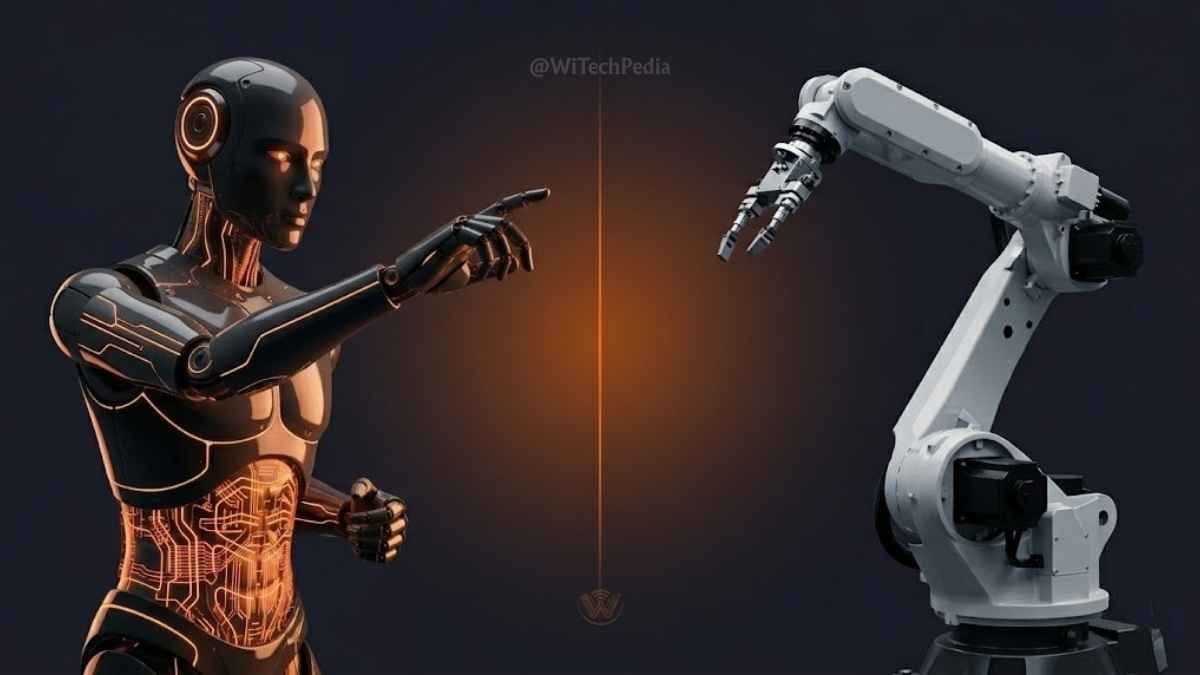
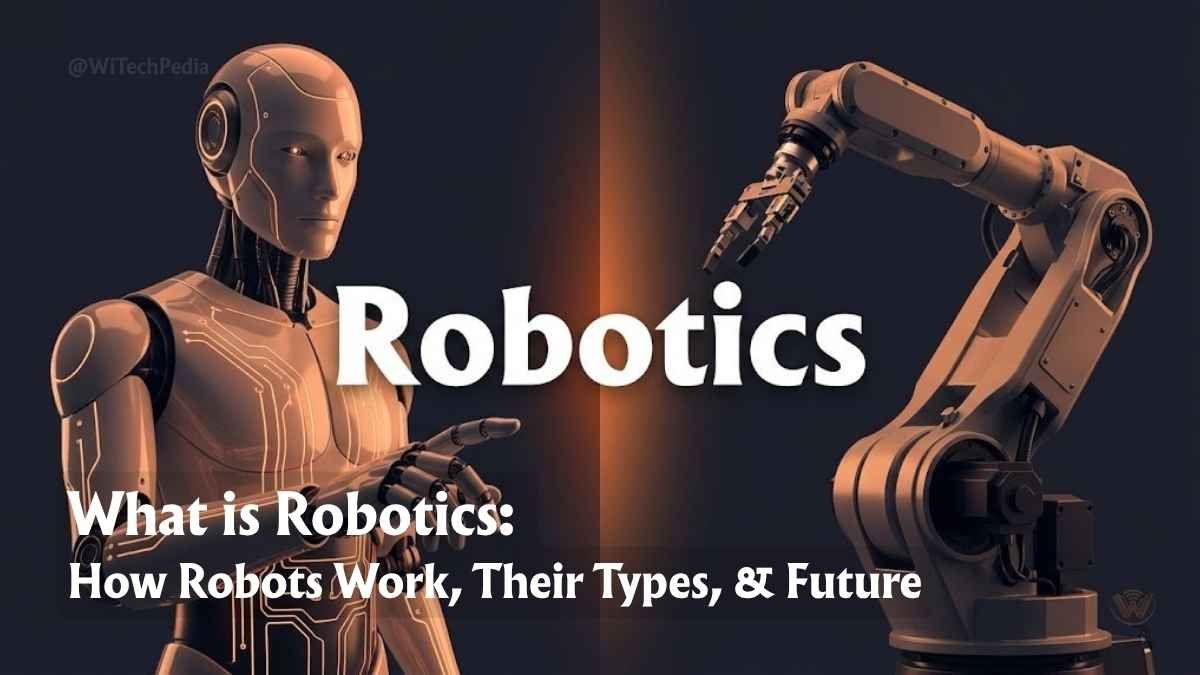
Robotics is the interdisciplinary branch of science and engineering concerned with the design, construction, operation, and application of robots. It draws from mechanical engineering, electrical engineering, computer science, and — increasingly — artificial intelligence (AI) and machine learning.
At its simplest, robotics is the science of making machines that can sense their environment, process information, and take physical action — either autonomously or under human direction.
The word “robot” itself comes from the Czech word robota, meaning forced labor or drudgery, first used in Karel Čapek’s 1920 play R.U.R. (Rossum’s Universal Robots). But today’s robots are far more sophisticated than Čapek imagined — and far more integral to modern civilization.
A Brief History of Robotics
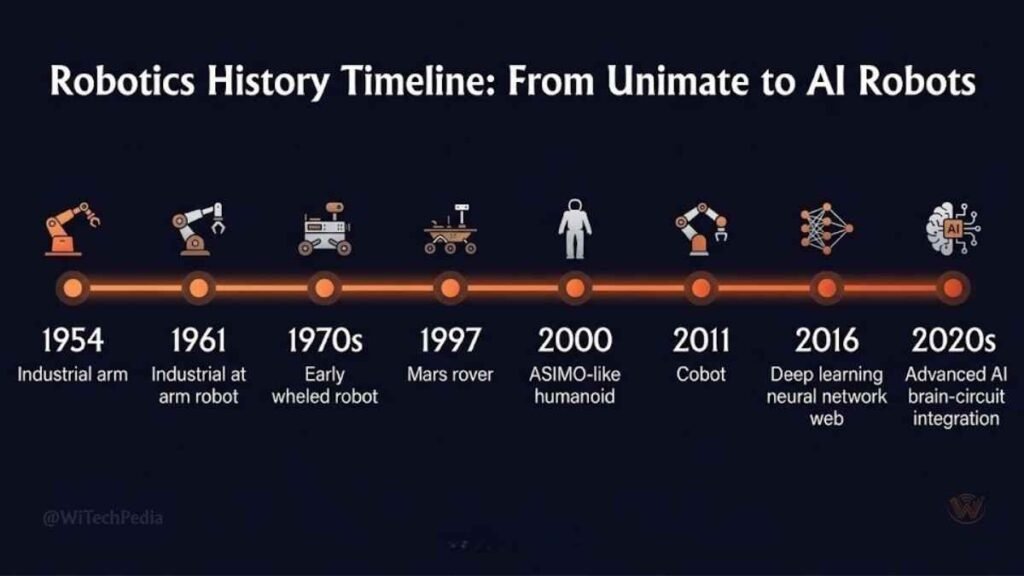
Understanding where robotics came from puts its explosive present — and future — in perspective.
- 1954 — George Devol patents the first programmable robotic arm, laying the foundation for industrial automation.
- 1961 — Unimate, the first industrial robot, is deployed at a General Motors plant in New Jersey to handle die-casting.
- 1970s — Stanford’s robotic arm brings computer-controlled manipulation into research labs worldwide.
- 1997 — NASA’s Sojourner rover explores Mars, proving robots can operate autonomously in extreme, remote environments.
- 2000 — Honda’s ASIMO debuts as a landmark bipedal humanoid robot.
- 2011 — IBM’s Watson demonstrates AI-driven cognition; robot-AI integration begins in earnest.
- 2016 onwards — Deep learning transforms robot perception; collaborative robots (cobots) enter factory floors.
- 2020s — Generative AI and large language models begin fusing with robotics, enabling natural-language robot control.
Core Components of a Robot
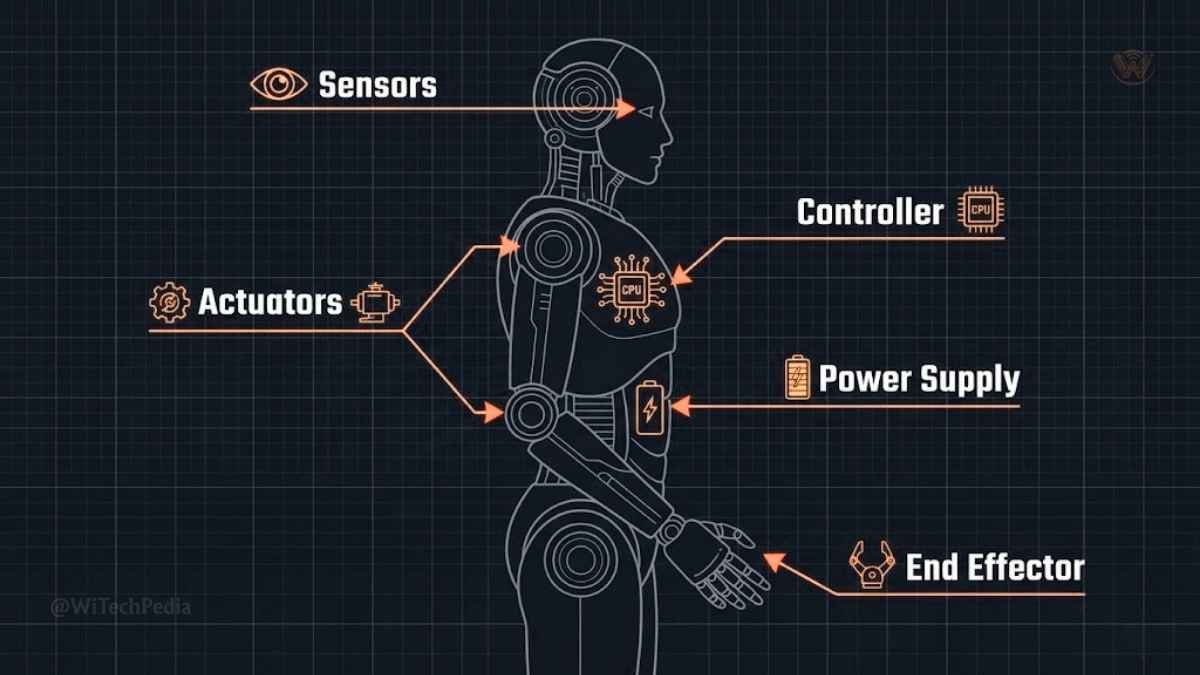
Every robot — regardless of size, purpose, or complexity — is built from the same fundamental building blocks.
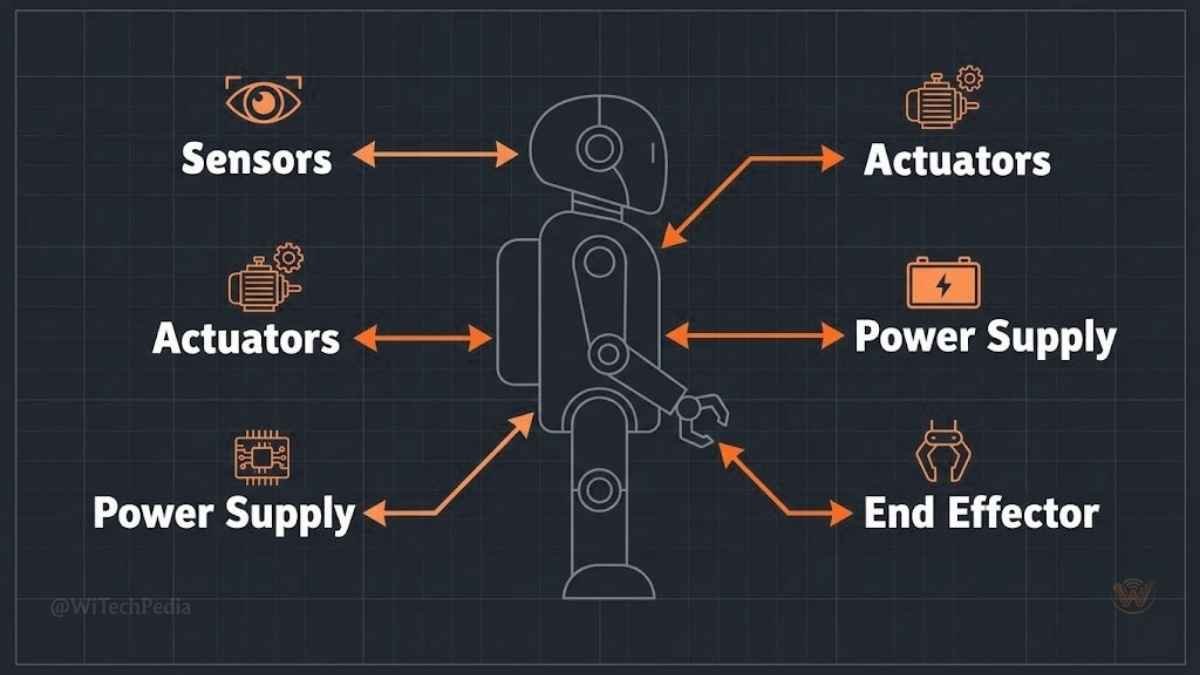
1. Sensors (Perception)
Sensors are a robot’s eyes and ears. They collect data from the environment:
- Cameras and LIDAR — for visual mapping and obstacle detection
- Ultrasonic and infrared sensors — for proximity measurement
- Force/torque sensors — to measure physical pressure and contact
- GPS and IMU (Inertial Measurement Unit) — for positioning and orientation
2. Actuators (Action)
Actuators convert energy into physical movement. These include:
- Electric motors (most common)
- Pneumatic and hydraulic actuators (for heavy-duty work)
- Piezoelectric actuators (for micro-precision tasks)
You may also link

3. Controller (Brain)
The controller is the robot’s onboard computer. It processes sensor data, runs control algorithms, and sends commands to actuators. Modern controllers often run real-time operating systems (RTOS) and embedded software.
4. Power Supply
Robots are powered by batteries, mains electricity, hydraulic pressure, or — in space — solar panels. Power management is a critical design constraint.
5. End Effectors
The “hand” of a robot. End effectors can be grippers, welding torches, surgical instruments, paint sprayers, or any tool that interacts with the physical world.
Types of Robotics
Robotics is not one field — it’s a family of disciplines. Here are the major categories.
Industrial Robots
The workhorses of manufacturing. Industrial robots are reprogrammable, multi-axis manipulators designed for high-speed, high-precision repetitive tasks.
Common uses:
- Welding and painting in automotive manufacturing
- Assembly and packaging in consumer electronics
- Palletizing and material handling in logistics
Key players: ABB, FANUC, KUKA, Yaskawa
Service Robots
Designed to operate in human environments, performing useful tasks for people or organizations.
- Professional service robots: surgical robots (e.g., da Vinci), inspection drones, bomb-disposal robots
- Personal service robots: robotic vacuum cleaners (Roomba), lawn mowers, companion robots
Collaborative Robots (Cobots)
Cobots are designed to work alongside humans safely — unlike traditional industrial robots, which operate behind safety cages. They use force-sensing to detect human contact and stop immediately. Companies like Universal Robots and Rethink Robotics pioneered this space.
Mobile Robots
Robots that move through their environment:
- Autonomous Mobile Robots (AMRs) — navigate warehouses using AI and maps
- Unmanned Ground Vehicles (UGVs) — military and search-and-rescue applications
- Unmanned Aerial Vehicles (UAVs/drones) — delivery, agriculture, surveillance
Humanoid Robots
Robots built to replicate human form and motion. Notable examples:
- Boston Dynamics Atlas — advanced bipedal locomotion
- Tesla Optimus — designed for factory and general-purpose work
- Agility Robotics Digit — warehouse applications
Medical Robots
One of the fastest-growing segments:
- Surgical robots (da Vinci system)
- Rehabilitation exoskeletons
- Pharmacy automation
- AI-assisted diagnostic robots
Soft Robots
Made from flexible, compliant materials rather than rigid metal. Inspired by biological organisms (octopuses, worms), soft robots excel in environments where rigid robots fail — handling delicate objects, navigating tight spaces.
Robotics vs. Artificial Intelligence: What’s the Difference?
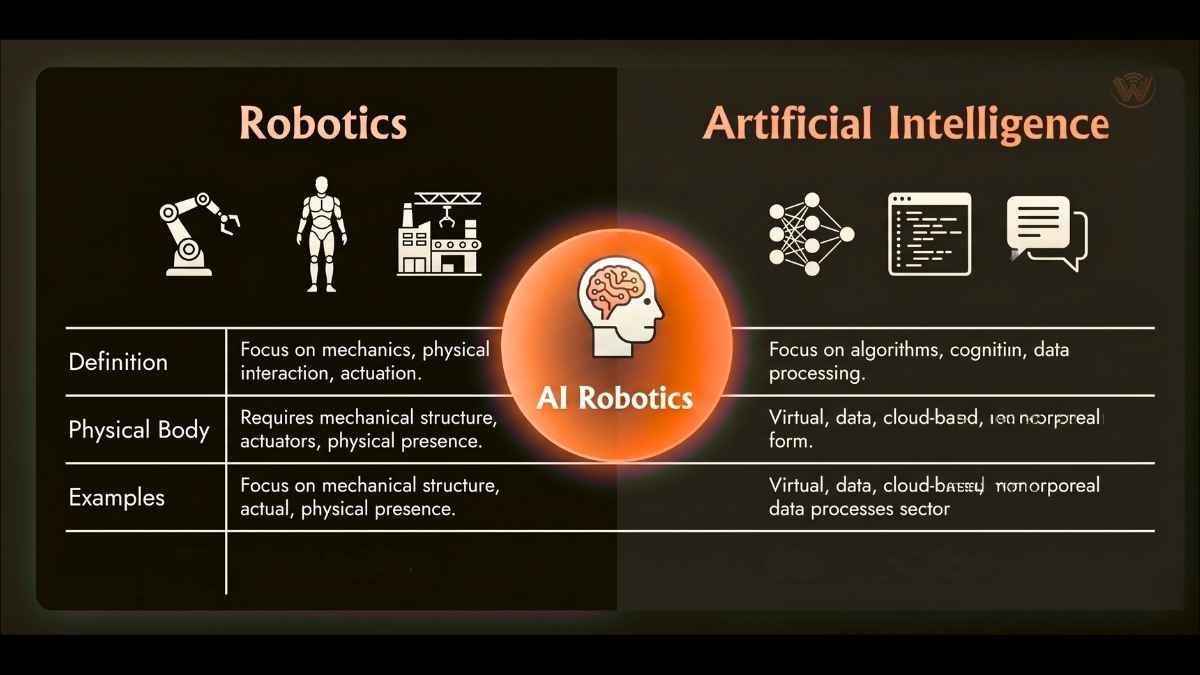
This is one of the most common points of confusion.
| Aspect | Robotics | Artificial Intelligence |
|---|---|---|
| Definition | Engineering of physical machines that act in the world | Software systems that simulate human-like intelligence |
| Core domain | Mechanical + electrical + software | Computer science + mathematics + data |
| Physical body | Always (it’s a machine) | Not required |
| Examples | Industrial arms, surgical robots, drones | ChatGPT, image classifiers, recommendation engines |
| Overlap | AI powers autonomous robots | AI can control robotic systems |
| Without the other | Rule-based robots (pre-AI era) | Pure software AI (no physical form) |
In modern systems, the distinction blurs. AI robotics — where machine learning and computer vision give robots the ability to adapt, learn, and make decisions — is the dominant paradigm today.
How Robotics Works: The Sense-Plan-Act Loop
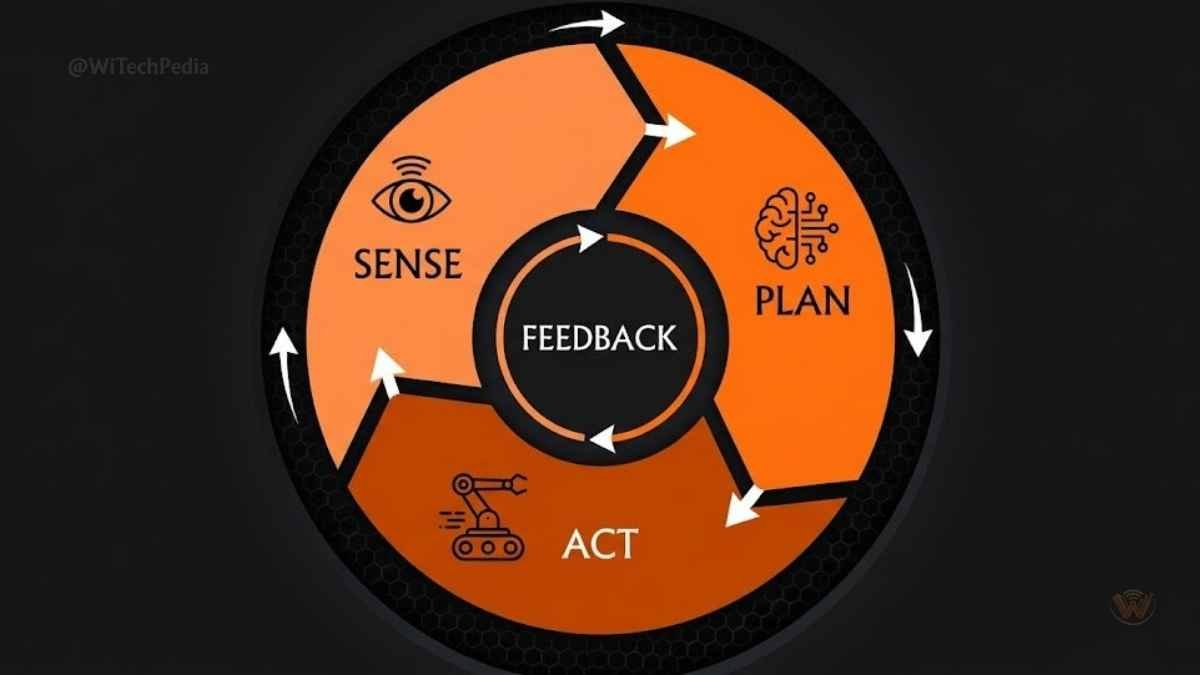
Most autonomous robotic systems operate on a foundational control cycle:
SENSE → PLAN → ACT → (repeat)- Sense — Sensors gather data about the robot’s environment (obstacles, positions, forces).
- Plan — The controller processes this data, runs algorithms (path planning, object recognition, decision trees), and decides on an action.
- Act — Actuators carry out the action (move an arm, navigate a corridor, pick up an object).
- Feedback — Sensors confirm the result, and the cycle begins again.
Modern AI-powered robots add a learning layer — the system improves its plans over time based on the outcomes of past actions, using techniques like reinforcement learning.
Key Robotics Technologies
Robot Operating System (ROS)
ROS is an open-source middleware framework that has become the de facto standard for robotics development. It provides tools, libraries, and conventions for building robot software, handling everything from sensor communication to motion planning. More on ROS →
Computer Vision
Enables robots to interpret visual data — identifying objects, mapping environments, tracking movement. Underpinned by deep learning architectures like CNNs. Essential for autonomous vehicles, surgical robots, and pick-and-place systems.
SLAM (Simultaneous Localization and Mapping)
A critical algorithm that allows a robot to build a map of an unknown environment while simultaneously tracking its own position within it. Used in autonomous cars, warehouse robots, and exploration drones.
Motion Planning
Algorithms that calculate the optimal path for a robot to move from point A to point B while avoiding obstacles. Key algorithms include A*, RRT (Rapidly-exploring Random Trees), and potential field methods.
Force Control and Haptics
Robots increasingly need to sense and control the forces they exert — critical for assembly tasks, surgical precision, and human-robot collaboration. Haptic feedback systems let robots “feel.”
Real-World Applications of Robotics
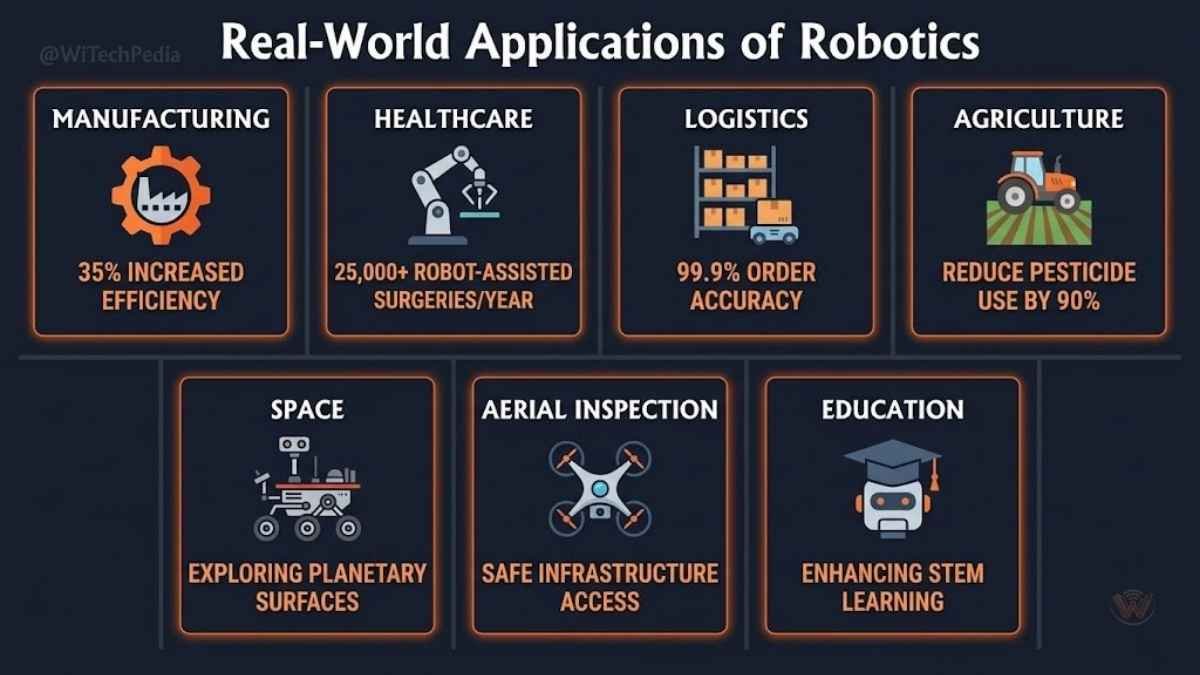
Manufacturing & Industry
Robotics transformed manufacturing long before the AI era. Today, automotive plants like Tesla’s Gigafactories deploy thousands of robots for welding, painting, and assembly with sub-millimeter precision. The Internet of Things (IoT) connects these systems into unified smart factories.
Healthcare & Surgery
The da Vinci Surgical System has performed over 10 million procedures worldwide. Robots offer unmatched precision, smaller incisions, and faster patient recovery. Rehabilitation robots like EksoGT help stroke survivors regain mobility.
Logistics & Warehousing
Amazon deploys over 750,000 robots across its fulfillment network. Kiva robots (now Amazon Robotics) navigate warehouse floors autonomously, dramatically increasing throughput and reducing human injury from heavy lifting.
Agriculture
Agricultural robots (agrobots) address labor shortages and sustainability challenges:
- Autonomous tractors (John Deere’s AutoDrive)
- Fruit-picking robots (Abundant Robotics)
- Crop-monitoring drones
Space Exploration
NASA’s Perseverance rover and Ingenuity helicopter on Mars represent the pinnacle of remote robotics. With communication delays of up to 24 minutes, these robots operate with significant autonomy. Learn more about space computing →
Defense & Security
Military robots include bomb-disposal units (iRobot PackBot), surveillance drones (General Atomics MQ-9 Reaper), and autonomous systems for logistics support.
Education
Platforms like LEGO Mindstorms, VEX Robotics, and Arduino-based systems have made robotics education accessible to students worldwide, feeding a global pipeline of engineers.
The Future of Robotics
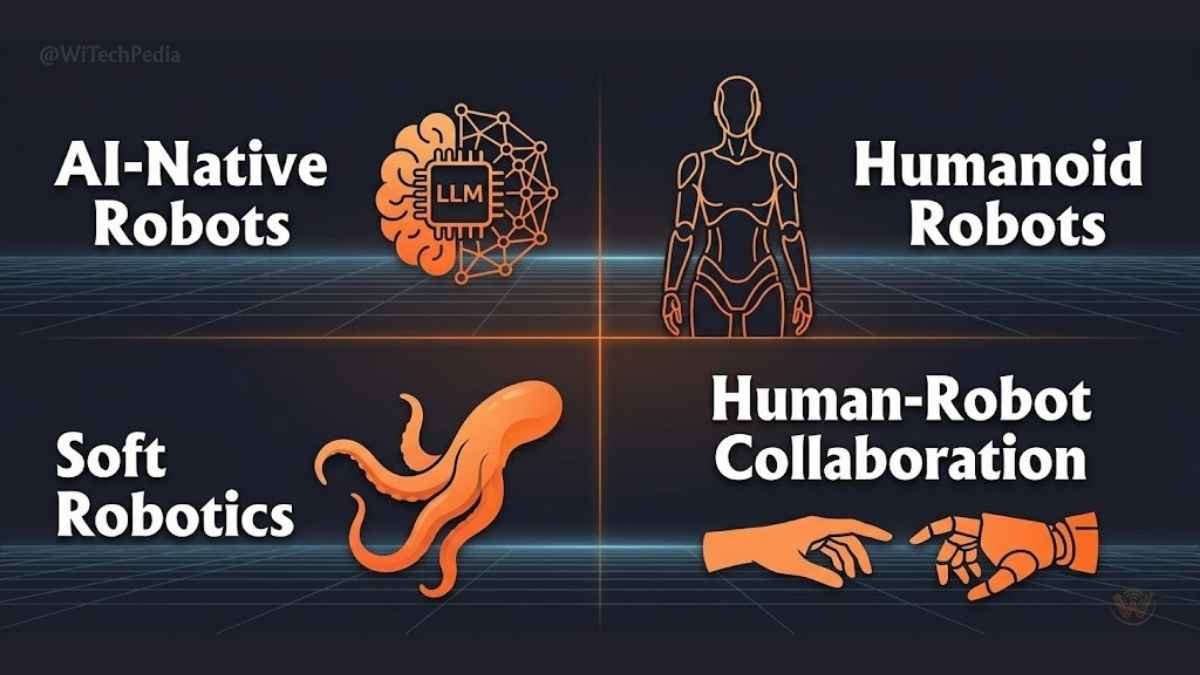
The next decade will be defined by four converging forces:
1. AI-Native Robots
Large language models (LLMs) like those powering ChatGPT are being integrated with robotics. Robots that understand natural language commands — “pick up the red box and place it on the shelf” — are moving from research demos to commercial products. Google DeepMind’s RT-2 demonstrated this breakthrough in 2023.
2. Humanoid Robots at Scale
Tesla’s Optimus, Figure AI’s Figure 01, and Agility Robotics’ Digit are racing toward general-purpose humanoid robots priced below $20,000. If successful, the implications for labor markets and everyday life are staggering.
3. Soft and Bio-Inspired Robotics
Nature-inspired designs — robots that move like fish, climb like geckos, or grip like octopus tentacles — will unlock entirely new application domains where rigid robots fail.
4. Human-Robot Collaboration
Rather than replacing humans entirely, the near-term future belongs to cobots — systems designed to augment human capability. Exoskeletons for factory workers, AI co-pilots for surgeons, and assisted-living robots for aging populations.
Robotics Programming: How Are Robots Coded?
Robots are programmed using a layered stack of tools and languages.
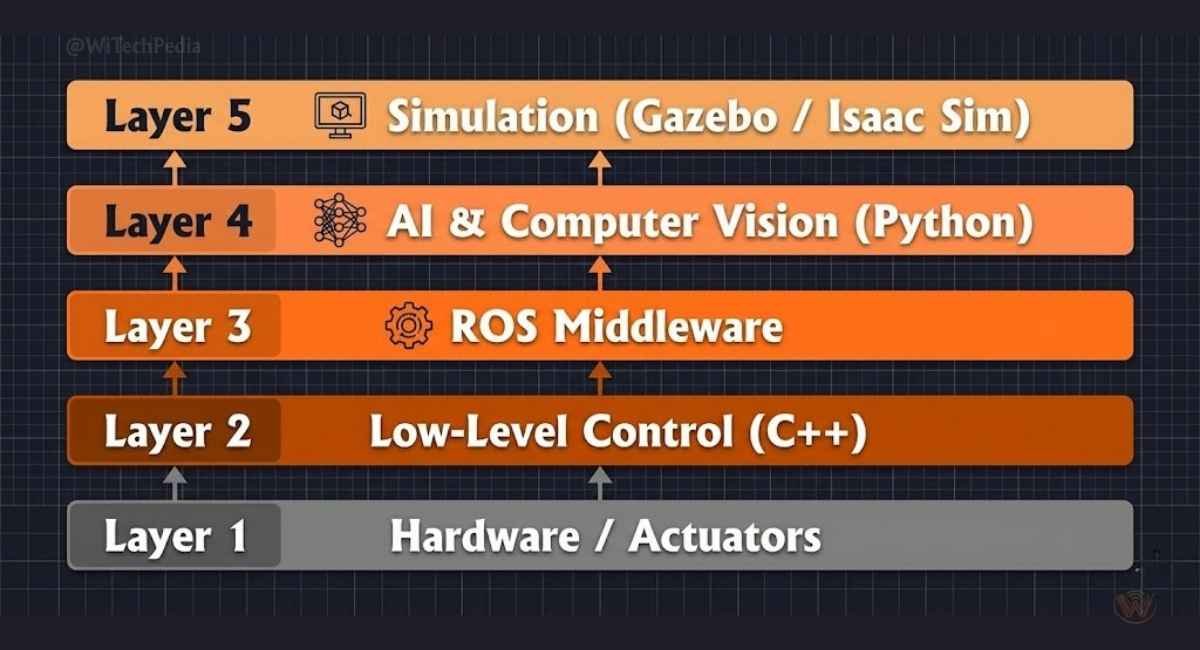
Low-level control: C and C++ dominate for performance-critical real-time control systems.
Middleware: ROS (Robot Operating System) abstracts hardware differences and enables modular software design.
High-level AI: Python powers most machine learning and computer vision work, using libraries like TensorFlow, PyTorch, and OpenCV.
Simulation: Before deploying on physical hardware, robots are tested in simulators like Gazebo, Isaac Sim (NVIDIA), and MuJoCo — saving time, money, and avoiding hardware damage.
For those looking to enter the field, the Python programming guide on WiTechPedia and our introduction to machine learning are excellent starting points.
Robotics Ethics and Society
No complete discussion of robotics is honest without confronting its societal dimensions.
Job displacement is real but nuanced. Historically, automation eliminates certain tasks while creating new roles — but the pace and breadth of modern robotics may outstrip the economy’s ability to adapt. The World Economic Forum projects that automation will displace 85 million jobs by 2025, while creating 97 million new ones — a net positive, but unevenly distributed.
Safety and liability: Who is responsible when an autonomous robot causes harm? Regulatory frameworks are lagging far behind technological capability.
Autonomous weapons: The development of lethal autonomous weapons (LAWs) — drones and ground vehicles that can select and engage targets without human input — raises profound ethical questions that the international community has yet to resolve.
Privacy: Surveillance drones and data-collecting robots raise serious cybersecurity and privacy concerns.
Bias in AI robotics: If a robot’s vision system is trained on biased data, it may behave differently toward different people — with real-world consequences in policing, hiring, or healthcare.
Frequently Asked Questions (FAQ)
What is robotics in simple terms?
Robotics is the field of engineering and science focused on designing, building, and operating robots — machines that can sense their environment, process information, and perform physical actions. Modern robotics combines mechanical engineering, electronics, and artificial intelligence to create systems that can work autonomously or alongside humans.
What are the main types of robots?
The main types of robots are: industrial robots (manufacturing and assembly), service robots (healthcare, cleaning, personal assistance), collaborative robots or cobots (human-safe factory robots), mobile robots (autonomous vehicles and drones), humanoid robots (human-shaped machines), medical robots (surgical and rehabilitation), and soft robots (flexible, bio-inspired designs).
How is robotics different from artificial intelligence?
Robotics is the engineering of physical machines that act in the world. Artificial intelligence is software that simulates intelligent behavior. They are distinct fields that increasingly overlap: AI gives modern robots the ability to learn, adapt, and make decisions autonomously. A robot without AI follows pre-programmed rules; a robot with AI can respond to new situations it wasn’t explicitly programmed for.
What programming languages are used in robotics?
The most common languages in robotics are C++ (for real-time, performance-critical control), Python (for AI, machine learning, and high-level logic), and MATLAB (for algorithm prototyping). Most professional robotics development happens within the ROS (Robot Operating System) framework, which supports both C++ and Python.
Will robots replace human jobs?
Robots will automate many specific tasks — particularly those that are repetitive, dangerous, or physically demanding. However, economic history shows automation consistently creates new categories of work even as it eliminates others. The critical challenge is the transition period and ensuring workers in displaced roles have access to retraining and new opportunities. Roles requiring creativity, emotional intelligence, and complex judgment remain difficult to automate.
What is a cobot (collaborative robot)?
A collaborative robot, or cobot, is a robot designed to work safely in close proximity to humans. Unlike traditional industrial robots that operate behind safety barriers, cobots use force-sensing and speed-limiting technologies to stop instantly if they contact a person. They’re used in light assembly, quality inspection, and any task where human-robot teamwork improves efficiency. Universal Robots’ UR series is the market-leading cobot platform.
What is SLAM in robotics?
SLAM stands for Simultaneous Localization and Mapping. It’s an algorithm that enables a robot to build a map of an unknown environment while simultaneously tracking its own location within that environment — without GPS. SLAM is fundamental to autonomous vacuum cleaners, self-driving cars, warehouse AMRs, and Mars rovers.
The Bottom Line: Why Robotics Matters
Robotics is one of the most consequential technologies of the 21st century. Here are the essential takeaways:
- Robotics is interdisciplinary — it fuses mechanical engineering, electronics, computer science, and AI into machines that act in the physical world.
- There is no single “type” of robot — industrial arms, surgical systems, autonomous drones, humanoids, and soft robots are all radically different tools for radically different problems.
- AI is transforming robotics — the fusion of machine learning and physical machines is creating robots that learn, adapt, and make autonomous decisions at unprecedented levels.
- The applications are vast and growing — from manufacturing and healthcare to agriculture, space, and daily life, robots are already everywhere.
- Ethics must keep pace with technology — questions of job displacement, safety, autonomous weapons, and bias demand serious societal engagement.
The age of robotics is not coming. It’s already here. The question is whether you’ll be a passive observer or an active participant.
Want to go deeper? Subscribe to the WiTechPedia newsletter for weekly breakdowns of the technologies reshaping our world. Or explore our related guides: